
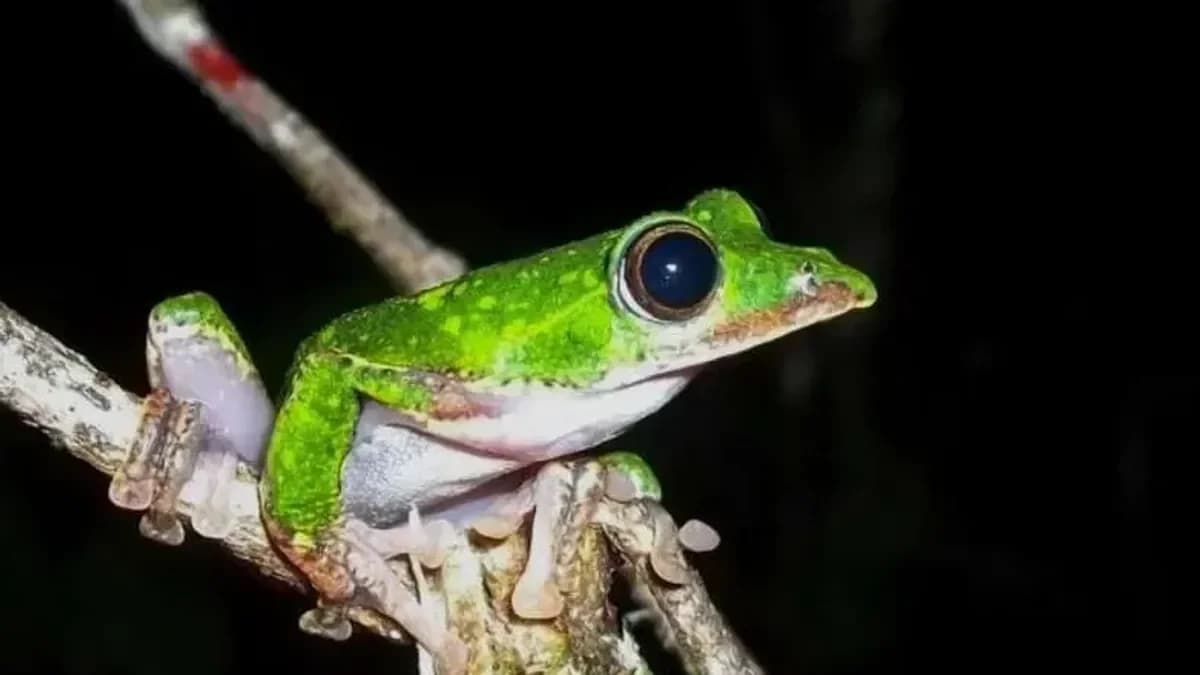
Researchers have described a new species of flying frog in the mountains of Sulawesi, Indonesia. Named Rhacophorus kurniatiae, it glides using its webbed feet and lays its eggs in a gelatinous mass suspended above water, a behaviour rarely seen in its family. The species was formally described in November 2026 in the journal Zootaxa.
A frog that glides rather than flies
The word "flying" is misleading. Like other Asian rhacophorid frogs, Rhacophorus kurniatiae doesn't flap wings: it spreads its large webbed feet, which act like tiny parachutes, and glides from branch to branch to escape predators or move between trees. Bright green and small enough to fit on a cheek, it lives in the damp canopy of mountain forests, far from prying eyes.
Eggs laid in jelly, unlike anything seen in its relatives
This is where the frog really stands out. Most species in its family build a foam nest, a protective froth in which the tadpoles develop. This one does things very differently: the female deposits her eggs in a gelatinous mass, attached to vegetation just above the water. Once hatched, the tadpoles simply drop into the pool below. This egg-laying method, rare within the group, helped scientists identify it as a distinct species.
Discovered beside Lake Coca-Cola
The setting itself is striking: a highland pool perched at over 1,860 metres, in the Mekongga Mountains of Sulawesi, nicknamed Danau Coca-Cola, or "Coca-Cola Lake". Researchers counted thousands of frogs there. To confirm the find, they compared 28 physical features, analysed DNA and recorded calls: a pointed snout and distinctive calls settled the matter.
A name honouring a herpetologist
Rhacophorus kurniatiae is named after the late Hellen Kurniati, an Indonesian herpetologist and specialist in her country's amphibians. Behind the discovery is an international team bringing together Indonesian researchers and the University of California, Davis, following expeditions carried out between 2009 and 2013. Describing a species can take years, as fieldwork, genetics and calls must all be cross-checked before it can be made official.
Indonesia, a treasure trove of still-unknown species
This frog is a reminder that nature still keeps secrets. Indonesia, an archipelago of thousands of islands, is home to some of the richest biodiversity on Earth, and new amphibian species are described there almost every year. Many live in forests under threat from deforestation, which makes recording them all the more urgent. For a closer look at amphibians without travelling so far, the aquariums and vivariums at some animal parks showcase some spectacular specimens, and curiosity sometimes begins at the bottom of a pond, out in nature.