
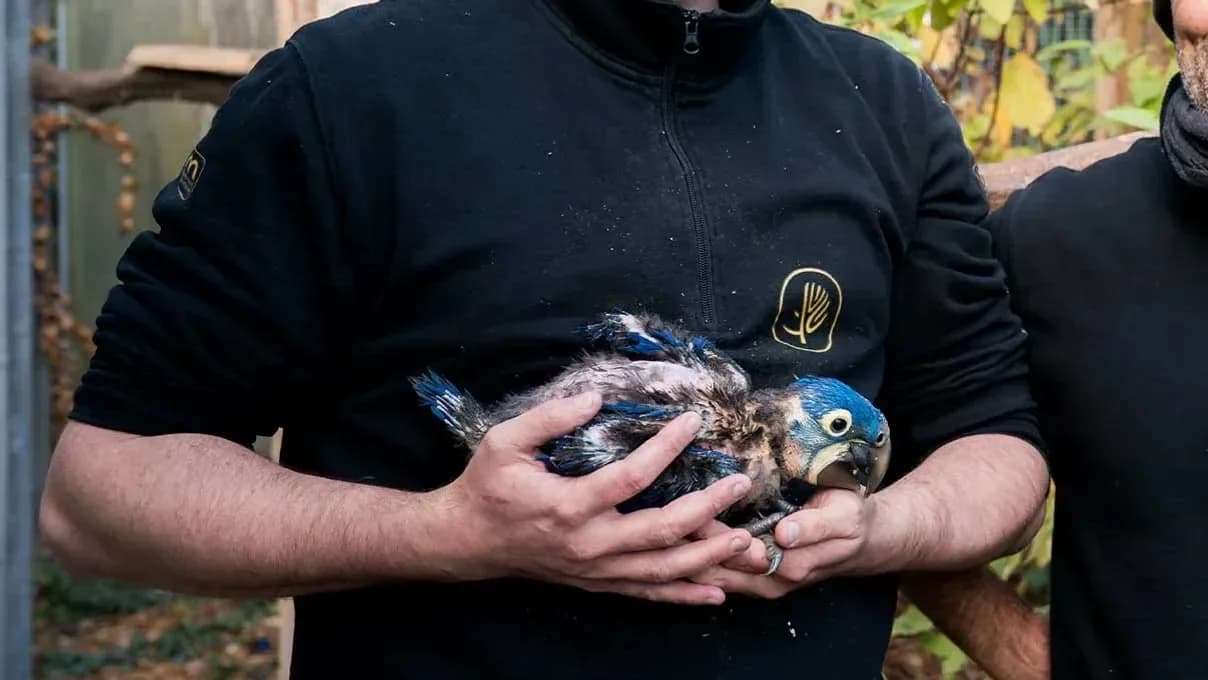
A hyacinth macaw chick was born in September at the Parc Zoologique et Botanique de Mulhouse. This species, the world's largest flying parrot, is classed as vulnerable by the IUCN. The egg was first incubated artificially before the chick was returned to its parents, with whom it will grow up until it is around four months old.
The world's largest flying parrot
Impossible to mistake it for anything else. The hyacinth macaw sports a dazzling cobalt blue plumage, set off by a bright yellow ring around the eye and at the base of the beak. At nearly a metre long, it is the largest flying parrot on the planet. Its massive beak, one of the most powerful in the bird world, effortlessly cracks the toughest shells, including the palm nuts it loves. In the wild, it lives in the forests and savannahs of Bolivia, Brazil and Paraguay. Faithful by nature, it usually pairs for life and nests in the hollows of large trees, where it can live for several decades. In other words, every individual matters a great deal for the species' future.
A birth under close watch
Breeding the species is tricky, and nothing is left to chance. At Mulhouse, the egg was first taken to the hatching house, where it was incubated artificially, as parents sometimes struggle to see incubation through to the end. Once hatched, the chick was returned to its parents, who are now rearing it in the nest. It will stay there until it is around four months old, giving it time to grow its feathers and build up strength before its first outings. Keepers monitored the egg closely, a demanding but essential process for birds notoriously difficult to breed in parks.
A bird classed as vulnerable
Behind the good news lies a fragile species. The hyacinth macaw is listed as "vulnerable" on the IUCN Red List, threatened by habitat destruction and, for a long time, by the illegal bird trade. Every birth in a park counts: the species is part of a European programme coordinated by EAZA, which brings together around 300 individuals in zoos across the continent. This network maintains a genetically monitored safety-net population, sheltered from the threats facing wild birds. A breeding success like Mulhouse's quietly strengthens this life insurance policy for the species.
When will we be able to see it?
Patience: the chick stays out of sight, tucked away in its nest, while it grows. It will be shown to the public once it is independent enough, in the coming months. Check on access to the macaw enclosure before your visit, as young birds are sometimes kept away from view. In the meantime, the Parc Zoologique et Botanique de Mulhouse and other French zoological parks are full of species to observe, and the fascination with birds continues out in the wild, binoculars around your neck.
Your questions, our answers
What is the hyacinth macaw born at Mulhouse Zoo?
The hyacinth macaw is the world's largest flying parrot, recognisable by its cobalt blue plumage and the yellow ring around its eye. It measures nearly a metre and lives naturally in Bolivia, Brazil and Paraguay. The Parc Zoologique et Botanique de Mulhouse announced the birth of a chick in September, following a closely monitored incubation. The species is classed as vulnerable by the IUCN.
Why is this birth important?
Because the hyacinth macaw is a fragile species, threatened by habitat destruction and the illegal bird trade. Breeding it in parks remains tricky: at Mulhouse, the egg had to be incubated artificially before the chick was returned to its parents. Every birth strengthens the European safety-net population, coordinated by EAZA, which numbers around 300 individuals in zoos across the continent.
When will we be able to see the baby macaw at Mulhouse Zoo?
The chick stays in the nest until it is around four months old, giving it time to grow its feathers and gain independence. It should be shown to the public in the months following its birth. Before travelling, check the latest information from the Parc Zoologique et Botanique de Mulhouse, as young birds are often kept out of sight at first.