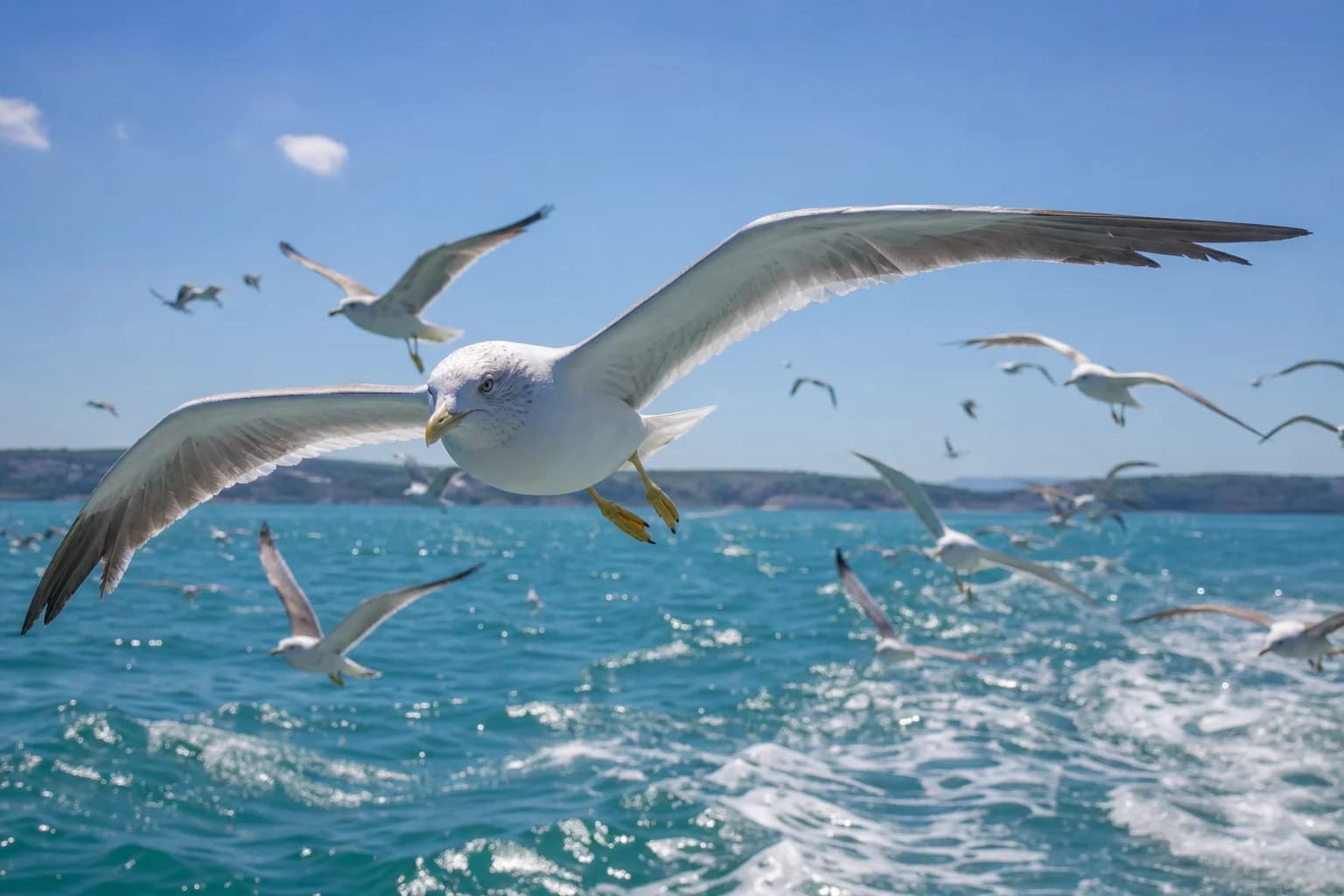
Yes, sleeping mid-flight is possible. The great frigatebird crosses the ocean for days on end by letting only one hemisphere of its brain rest at a time: this is known as unihemispheric sleep. The other half stays awake, one eye open, to hold its course and avoid obstacles.
Sleeping in mid-flight, without ever landing
The great frigatebird (Fregata minor) sometimes spends more than a week airborne over the Pacific without ever touching down. It snatches flying fish from the surface and glides for hours on rising air currents. Above the water, there's no branch or cliff ledge for a nap. An animal that fell fully asleep would drop, slow down or drift off course, so rest has to be earned with wings outstretched and the body still moving.
Unihemispheric sleep: half the brain on standby
In humans, both halves of the brain fall asleep together. In many birds, they switch off separately. One hemisphere slips into slow-wave sleep while the other stays active, controlling the eye that remains open on the opposite side. This unihemispheric sleep lets the animal recover while still keeping watch over its surroundings. Dolphins use it to come up for air; birds use it to stay on course.
The proof: frigatebirds fitted with electrodes
In 2016, Niels Rattenborg's team at the Max Planck Institute for Ornithology fitted tiny brain-activity recorders onto great frigatebirds in the Galápagos. The verdict: the birds really were sleeping in flight, mostly at night, in bursts of a few minutes while gliding on rising air currents. Sometimes just one half of the brain, sometimes both at once. In flight, these frigatebirds slept for only around 42 minutes a day, compared with more than twelve hours once back on land.
"Why they sleep so little in flight, even at night when they rarely hunt, remains a mystery."
What this half-sleep is for
Keeping one eye open means keeping a radar switched on. In flight, the awake half watches for other birds and obstacles, helping to avoid collisions. On the ground, the same mechanism helps spot predators. A 1999 study, also by Rattenborg, demonstrated this in mallard ducks: individuals placed at the edge of a row slept in unihemispheric mode 31% of the time, compared with 12% for those sheltered in the centre. Their outward-facing eye stayed open 86% of the time, fixed on the open space from which danger might appear.
Where to watch birds in France
You don't need to cross the Pacific to be amazed. In France, bird parks and nature reserves let you see herons, storks, flamingos and raptors just a few metres away. For a family outing, find an animal or bird park near you, or head out to spot wild birds on a walk in the countryside. Along hiking trails, you'll also come across plenty of species, this time with your own eyes wide open.
Your questions, answered
Which birds sleep while flying?
Only the great frigatebird has been proven to do so: in 2016, brain sensors caught it sleeping mid-flight above the Pacific. Other great flyers, such as the common swift, which stays airborne for months at a time, may well do the same, but direct EEG evidence is still lacking for them. The debate remains open as to just how widespread the phenomenon is among migratory birds.
What is unihemispheric sleep?
It's a form of sleep in which only one half of the brain rests at a time, while the other stays awake. The eye linked to the sleeping hemisphere closes, while the one linked to the active hemisphere stays open. This mode, seen in many birds and in dolphins, lets the animal recover without ever fully dropping its guard.
Do birds close their eyes to sleep?
Not always both at once. During unihemispheric sleep, one eye closes while the other stays open, watching out for danger. In mallard ducks positioned at the edge of a group, that outward-facing eye stays open the vast majority of the time. In ordinary sleep, both eyes close, just as with us.