Butterflies of the genus Colobura are everywhere in Central and South America. For more than two centuries, these insects were thought to belong to a single species. Recently, a team of researchers identified a third species, Colobura cryptica, which shares very similar characteristics with its relatives, challenging established knowledge about their evolution and coexistence.
An unexpected discovery
The new species was described in the journal Zootaxa by Anisha Sapkota, a PhD student at the Florida Museum of Natural History. By combining DNA analysis with subtle differences in wing patterns and the reflection of ultraviolet light, the researchers uncovered distinctions that had previously gone unnoticed. Remarkably, all three species occupy overlapping territories and can be seen at the same time, yet no evidence of interbreeding between them has been found.
An iconic butterfly with a hidden identity
The tropical forests of Central and South America are home to exceptional biodiversity. Costa Rica, for example, has around 500,000 species, five times more than Canada, despite being 200 times smaller in area. Among this diversity, certain animals and plants are particularly recognisable, such as trees of the genus Cecropia, which play an important role in the ecosystem. Colobura butterflies are just as emblematic of the region, as their caterpillars feed on the leaves of these trees.
The geographical range of Colobura is vast, stretching from the Andes to the Brazilian Amazon, via the Atlantic Forest of Brazil and Paraguay. Despite this wide distribution, scientists had long believed the genus contained only a single species, Colobura dirce, described by Carl Linnaeus in 1758. It was not until 2001 that a second species, Colobura annulata, was recognised, before the discovery of a third species complicated matters further.
A 150-year-old mystery
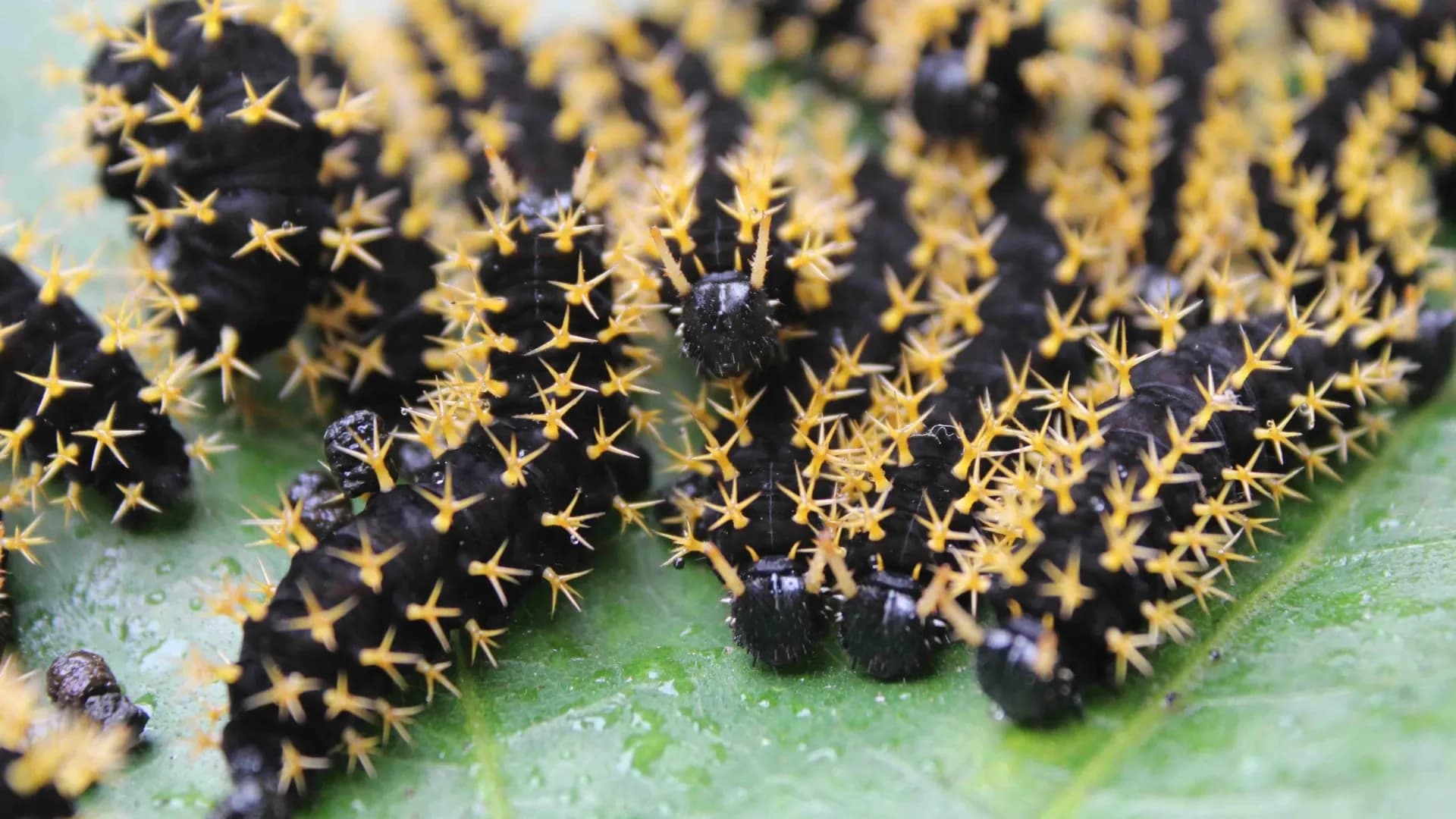
Telling adult Colobura butterflies apart is particularly difficult. Their wings are almost identical, with only slight variations in a grey band on the underside of the forewings. This band may be wider in some individuals, or may stop short of meeting a yellow band. The caterpillars, on the other hand, offer clearer clues, with velvety black bodies adorned with yellow projections that serve as a warning to predators.
The importance of these differences was recognised as early as 1852 by the Dutch entomologist Jan Sepp, who proposed that variations in the cream-coloured patterns on the caterpillars indicated two distinct species. However, this theory was dismissed for more than a century. It was not until 2001 that Keith Willmott and his colleagues rediscovered Sepp's observations and described a second species, Colobura annulata.
A discovery in Venezuela
Around 25 years later, a new clue emerged when Willmott's colleague, Andrés Orellana, observed Colobura caterpillars feeding on a young Cecropia tree in Venezuela. Although these caterpillars shared characteristics with the known species, they lacked the cream-coloured patterns. This observation prompted researchers to explore the possibility of a third species.
Anisha Sapkota, newly arrived at the Florida Museum's Shirey Lab, led the investigation. Together with her team, she designed a study combining genetic evidence with careful examination of the butterflies' anatomy. They analysed DNA samples from an ongoing survey of butterflies and moths in Costa Rica, as well as older specimens collected across tropical America.
Hidden clues in butterfly wings
During hours spent examining butterflies preserved in museum collections, Sapkota eventually spotted something unusual. The undersides of some wings showed a faint violet glow, the intensity of which varied from specimen to specimen. This observation suggested that these insects might reflect ultraviolet light, invisible to the human eye but detectable by many butterflies.
Measurements revealed a striking pattern: all the species reflect ultraviolet light, but the wavelengths differ. This led to the naming of the new species, Colobura cryptica, reflecting its previously hidden identity. Although the visible differences are extremely subtle, the ultraviolet measurements, caterpillar patterns and DNA analysis all tell a consistent story.
Distinctive features of each species
The three species can be told apart by several features: Colobura dirce has a grey band that widens slightly without reaching the yellow band, with cream-coloured teardrop-shaped markings on the abdomen; Colobura annulata has a uniform grey band that meets the yellow band, with cream-coloured ring-shaped markings; and Colobura cryptica has a uniform grey band that does not meet the yellow band, with no cream-coloured markings at all. Colobura dirce also has two subspecies with different ultraviolet reflectance values.
An intriguing coexistence
The discovery of an unknown butterfly species is significant in itself, but the geographical distribution of the three species makes this discovery particularly intriguing. All three are found in overlapping areas across Central and South America. Colobura dirce has the widest range, stretching from Mexico to south-east Brazil, while Colobura annulata is also widespread but absent from the Greater Antilles. Colobura cryptica, meanwhile, has the smallest known range, extending from southern Mexico to the Andean foothills.
These overlapping distributions raise important questions about evolution. How can three such similar species coexist without interbreeding? Researchers continue to explore these mysteries, seeking to understand the dynamics of these fascinating butterflies and their adaptation to their environment.