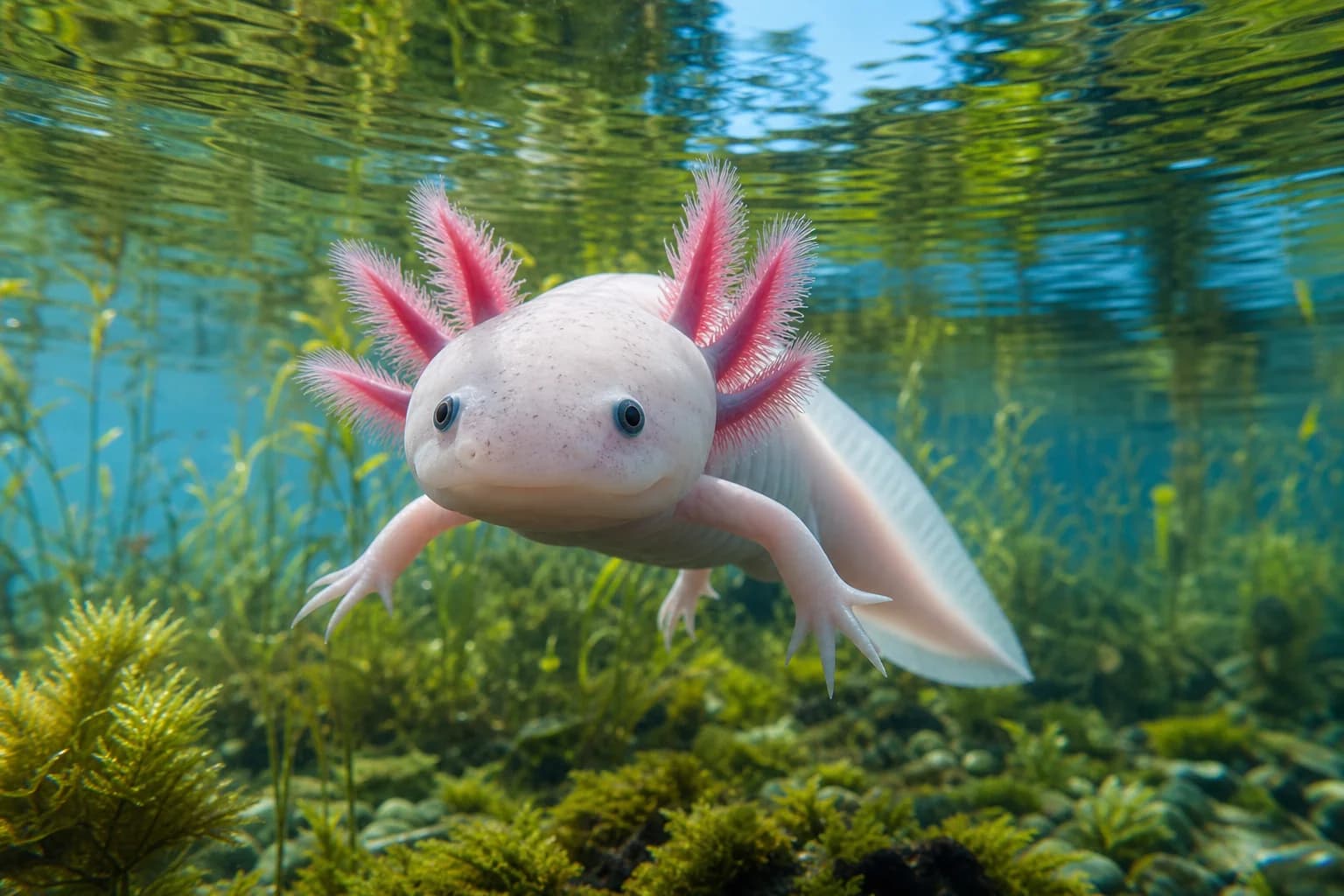
The axolotl is a Mexican amphibian famous for a rare ability: it can regenerate its legs, tail, and even parts of its heart and brain, without scarring. Endemic to the canals of Xochimilco, near Mexico City, it is now critically endangered, with fewer than 1,000 individuals left in the wild.
A regeneration champion
The axolotl has a talent that fascinates biologists. Where we would simply scar over a wound, it regenerates its legs, tail and spinal cord, and even portions of its heart and brain, all without scarring. An amputated limb grows back within a few weeks, bones, muscles and nerves included. This ability has made it a star of laboratories, studied in the hope of one day understanding regeneration in humans. In the axolotl, a wound heals without leaving a trace, whereas ours would form a permanent scar.
Why the axolotl lives almost nowhere but Xochimilco
This is a creature from the edge of the world. In the wild, the axolotl survives almost exclusively in the canals of Xochimilco, remnants of the Aztecs' floating gardens south of Mexico City. Another quirk: it stays in its larval form for its entire life, keeping its plumed gills and its characteristic little smile, a phenomenon known as neoteny. Unlike its cousins, it never transforms into a land-dwelling salamander. Its name comes from Xolotl, an Aztec god, and Mexicans regard it as a national treasure, to the point of featuring it on a banknote.
A critically endangered species
The outlook is alarming. The axolotl is classified as critically endangered, with reportedly fewer than 1,000 individuals left in the wild. A 2014 UNAM survey counted just 36 per square kilometre, compared with thousands a few decades earlier. The culprits are well known: water pollution, the urbanisation of Mexico City, and introduced fish, tilapia and carp, which devour its eggs. Once common in the lakes of the Valley of Mexico, the axolotl has seen its world shrink to a handful of canals. The results of a survey carried out in 2024 and 2025 are awaited and could confirm this decline.
How to save it, and where to see one
Not all hope is lost. In Xochimilco, UNAM researchers and farmers are testing "chinampa refuges", which combine ancestral farming methods with filtered water to recreate a healthy habitat. Captive-bred axolotls are gradually being reintroduced there. Paradoxically, the species is thriving in aquariums worldwide, where it can be observed up close. In France, several aquariums have them on display, including the Aquarium de La Rochelle, and some animal parks also keep them. A chance to discover this little dragon without leaving the country.
Able to grow back whatever it loses, the axolotl cannot, however, regenerate its habitat: this time, its survival depends on us.