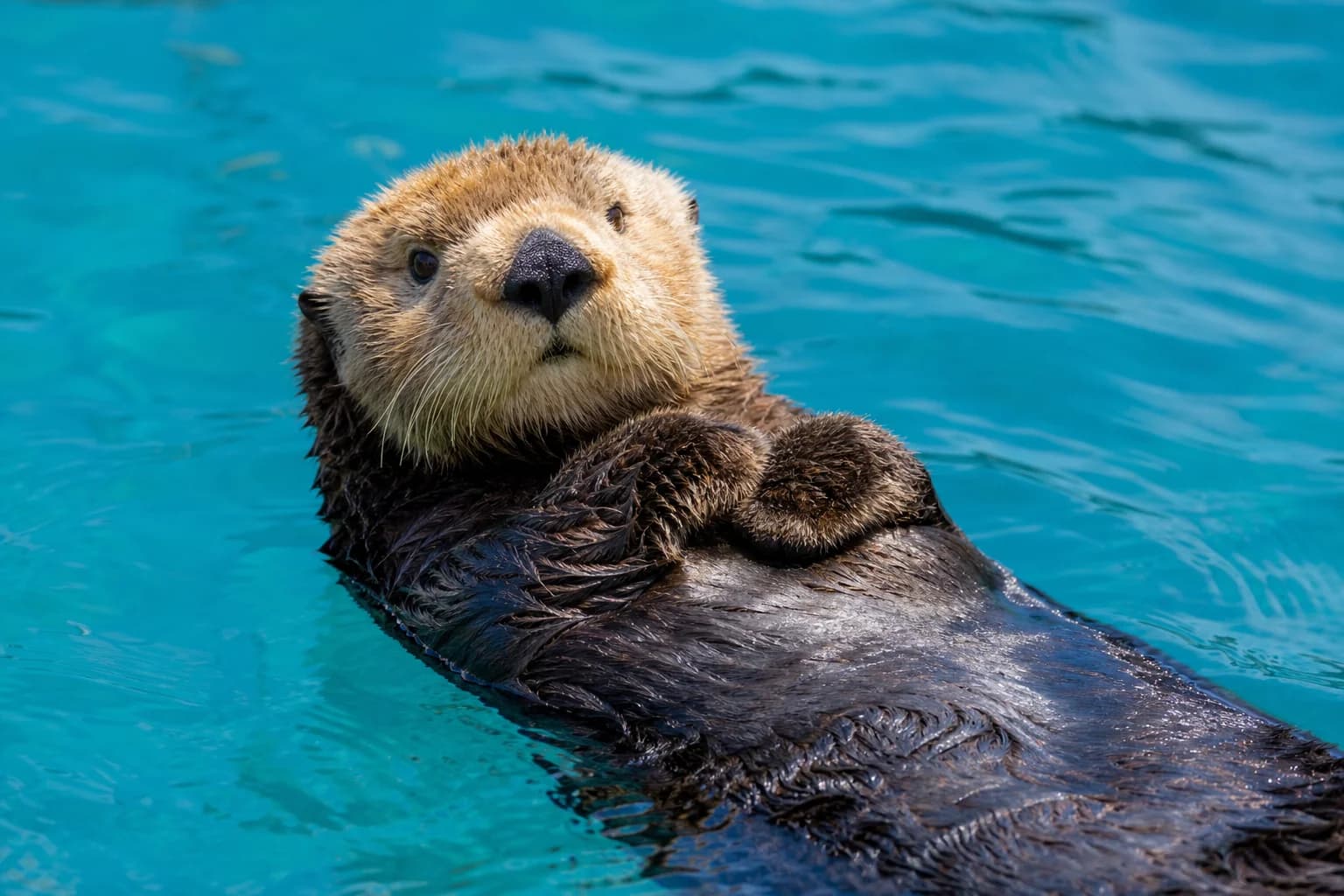
The sea otter (Enhydra lutris) sleeps lying on its back at the surface of the ocean. It doesn't sink thanks to its fur, the densest of any animal, which traps a layer of air against its skin. To avoid drifting off while asleep, it wraps itself in kelp (seaweed).
A nap on its back, out in the open ocean
It's a sight that fascinates aquarium visitors: the sea otter floats on its back, motionless, paws held up out of the water. Seen from a distance, it looks like a drifting clump of kelp. This is its natural resting position. In the North Pacific, it dozes like this for much of the day, between dives to feed. It leaves the water so rarely that it sleeps, grooms and even gives birth there.
Why the sea otter doesn't sink
It all comes down to its coat. The sea otter has the densest fur of any animal: up to nearly a million hairs per square inch, around 150,000 per square centimetre, according to the Monterey Bay Aquarium.
Unlike seals or whales, it has no insulating layer of blubber under its skin. Instead, its double-layered coat traps a layer of air against its body. This air keeps it warm and makes it float like a natural life jacket. To keep this air cushion in good condition, it grooms itself for hours every day and eats nearly a quarter of its body weight in food daily.
Kelp, its anti-drift mooring line
Floating is one thing; staying put through hours of sleep is quite another. The sea otter's solution comes down to one word: kelp. At the surface, it wraps itself in the long fronds of this giant seaweed so as not to drift while it sleeps, according to the NOAA Monterey Bay sanctuary.
The kelp acts as a living anchor, keeping it right above its larder. Otters also gather in "rafts", sometimes dozens strong. Some are even said to hold paws so as not to lose one another — a behaviour often described but still not firmly established by science.
Not to be confused with the otter in our rivers
Beware the false friend. The sea otter (Enhydra lutris) lives only in the North Pacific, from California to Alaska. The one found in our rivers is the Eurasian otter (Lutra lutra), a freshwater cousin that doesn't sleep afloat. Long on the brink of extinction, the Eurasian otter has been protected in France since 1976 and is now recolonising more than thirty départements, from Brittany to the Massif Central. Shy and mostly nocturnal, it remains very hard to spot in the wild.
Where to see otters in France
Good news for a family outing: Océanopolis, in Brest, is the only park in France to feature sea otters, alongside Eurasian otters, on its dedicated trail. Elsewhere, you'll mostly come across Asian small-clawed otters, the smallest in the world, in zoological parks such as the Tête d'Or park in Lyon. To try to spot a wild Eurasian otter, arm yourself with patience by rivers in Brittany or the Auvergne, at dawn. Start by checking out our nature outing ideas and the aquariums to visit near you.