
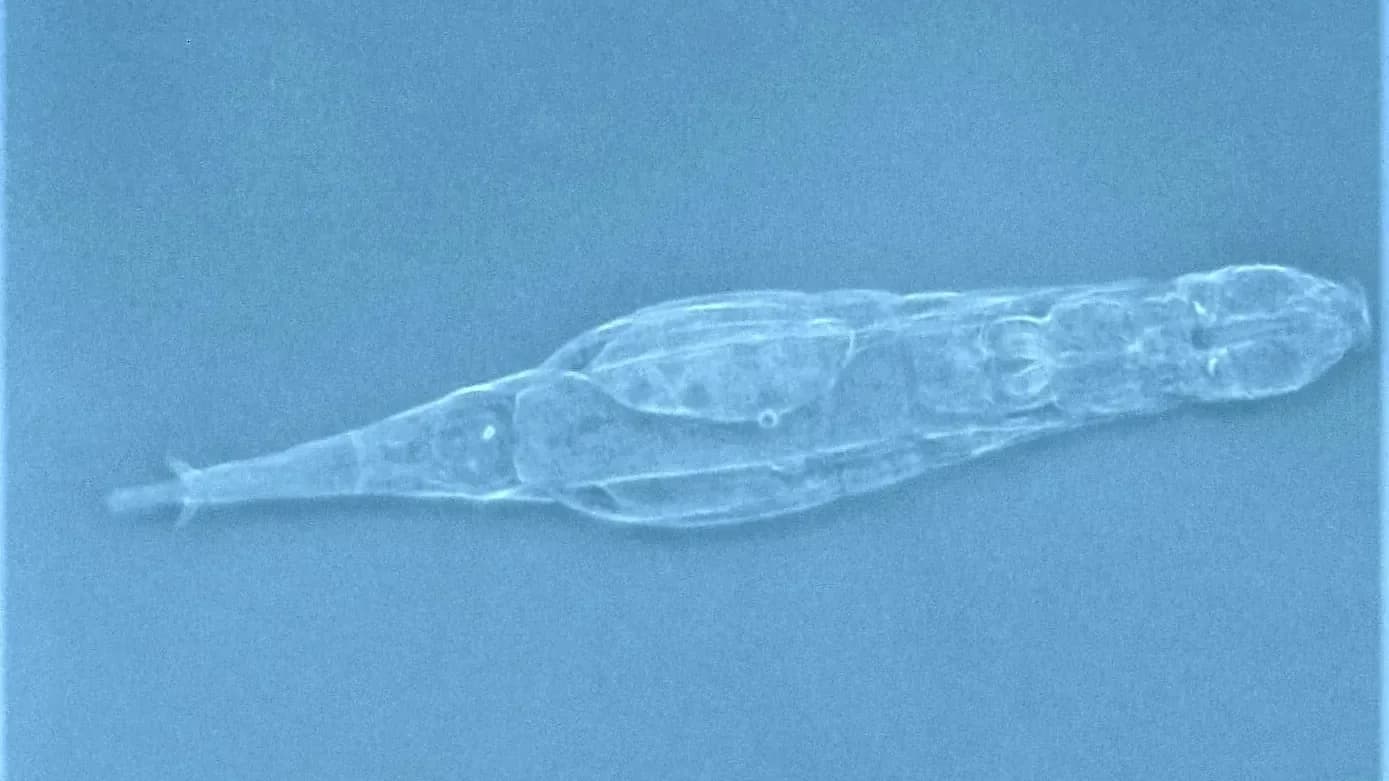
A bdelloid rotifer, a microscopic animal extracted from Siberian frozen soil around 24,000 years old, has come back to life after thawing. It began moving, feeding, and then reproducing on its own. The study, published in 2021 in the journal Current Biology, smashes every known record for animal survival under freezing.
An animal woken after 24,000 years in ice
It all began in the Siberian permafrost, near the Alazeya river, where a Russian team from the Soil Cryology Laboratory took a sample at a depth of 3.5 metres. Inside it lay a bdelloid rotifer, a multicellular animal smaller than a grain of sand, from the genus Adineta. Radiocarbon dating of the surrounding soil placed it at around 24,000 years old: the animal was trapped in ice back when woolly mammoths still roamed the tundra.
How do you survive 24,000 years frozen?
The secret has a name: cryptobiosis. Faced with extreme cold, the rotifer almost completely shuts down its metabolism, dehydrates itself and pauses, like a file put into sleep mode. Neither dead nor alive, it travels through the millennia without ageing. Tardigrades and certain microscopic worms use the same trick, but none had ever proven such endurance. Until now, these rotifers were thought capable of holding out for around ten years at -20°C, not hundreds of centuries.
Back to life, it cloned itself
Once thawed in the lab, the animal didn't just start moving and feeding again. It also reproduced, through parthenogenesis: a form of cloning, without a male or fertilisation, in which the female gives birth to copies of herself. Researchers went on to raise an entire lineage from this survivor of the Ice Age. Intriguingly, this rotifer may even belong to a species still unknown to science.
Why this discovery excites scientists
Stas Malavin, co-author of the study, sees it as the strongest evidence to date that a multicellular animal can endure tens of thousands of years in cryptobiosis. The stakes go beyond mere curiosity: understanding how a living creature protects its cells from freezing matters for cryopreservation, from safeguarding endangered species to dreams of hibernation for space travel. Every record broken raises the same question: just how long can life be put on pause?
The quiet champions of extreme survival
These feats don't play out in vast enclosures, but on a microscopic scale. Tardigrades, nematodes and rotifers inhabit roof moss, a frozen puddle or tundra soil, and spring back to life as soon as water returns. This tiny, indestructible life turns up almost everywhere, often unnoticed, including right out in nature near you. Aquariums are also teeming with creatures boasting quiet superpowers. The same tenacity, on a larger scale, explains how crocodiles made it through the extinction of the dinosaurs, when so many others vanished.