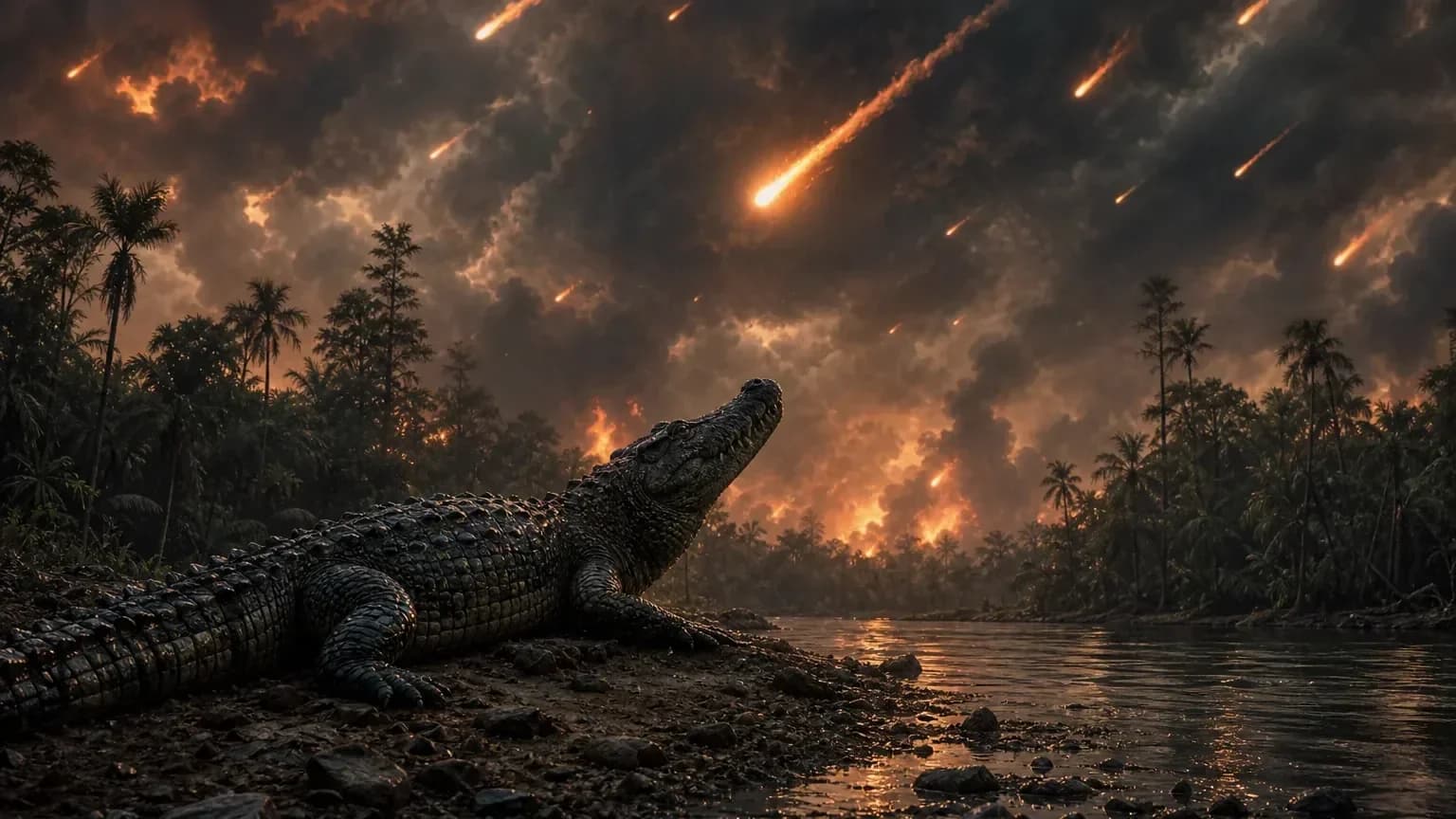
Researchers at University College London (UCL) have carried out a detailed study exploring why crocodiles survived the devastating asteroid impact that wiped out the dinosaurs. Their analysis focused on the evolution of crocodilians over the past 250 million years, highlighting their affinity for warm climates. Unlike other species, the ancestors of crocodiles were able to adapt to shifting climate conditions, moving towards more temperate regions whenever temperatures dropped.
A study based on fossils and climate simulations
To carry out their research, the scientists examined more than 7,000 fossils and records from over 400 species, both living and extinct. By combining this data with computer models reconstructing the Earth's climate and geography over the past 245 million years, they were able to draw significant conclusions. The results show that tropical and subtropical regions continued to provide suitable habitats for crocodile ancestors even after the asteroid impact, while living conditions for many dinosaur species rapidly deteriorated.
Tropical refuges as the key to survival
The researchers studied how conditions on Earth changed following the asteroid impact. Their simulations revealed that equatorial areas could remain warm enough to support crocodile ancestors, creating refuges where surviving populations could hold on and reproduce. Non-avian dinosaur habitats, by contrast, shrank dramatically after the impact, making their survival far more difficult. Dr Alfio Alessandro Chiarenza, lead author of the study, said that the asteroid impact did not make the Earth uniformly hostile for every species.
Thanks to their affinity for warm environments, crocodiles were able to find themselves in areas where the climate remained favourable, such as near the equator. These refuges most likely allowed crocodile populations to survive and later diversify.
An impressive past diversity
Although modern crocodiles share certain characteristics, their evolutionary history reveals a striking diversity of body shapes, sizes and lifestyles. The pseudosuchian group, the ancestors of crocodiles, once included heavily armoured herbivores, land-based predators, as well as giant species weighing over a tonne.
Among these fascinating species was Sarcosuchus, a colossal predator nicknamed the "super crocodile", which could grow up to 12 metres long. Another ancestor, Postosuchus, was a land-based hunter capable of moving on two or four legs. Dr Chiarenza noted that although crocodile ancestors evolved significantly over time, their link to climate remained remarkably constant.
Reconstructing 245 million years of climate
To study this relationship, the researchers reconstructed the temperature and rainfall preferences of 400 species of crocodiles and their ancestors. They drew on fossil evidence, evolutionary family trees and detailed maps of present-day crocodile habitats. By comparing these preferences with reconstructions of ancient geography and climate, they were able to identify suitable habitats at different points in Earth's history.
A clear pattern emerged: crocodile ancestors generally tracked warmer conditions as the planet's climate changed, spreading out during warm periods and retreating to tropical regions when temperatures fell. For example, around 50 million years ago, during the early Eocene, global temperatures were roughly 10°C higher than today, and the polar regions had no permanent ice. At that time, crocodile ancestors lived at high latitudes in North America, Europe and even Antarctica.
Notable exceptions to the rule
While this preference for warm climates held steady overall, the researchers identified two significant exceptions. During the Cretaceous Thermal Maximum, around 94 million years ago, global temperatures rose by 14°C above modern levels. One branch of the crocodile family tree evolved to tolerate hotter conditions than most other members of their lineage. Another adaptation took place around 34 million years ago in Australia, where a group of now-extinct crocodiles managed to adapt to increasingly arid environments as the continent dried out.
The immediate aftermath of the asteroid impact
The researchers also explored the immediate environmental consequences of the Chicxulub asteroid impact, which led to the extinction of the majority of dinosaurs. They examined various possible scenarios, such as sunlight being blocked by dust and ash, as well as rising carbon dioxide levels linked to volcanic eruptions. The simulations showed that even with a 5% or 10% reduction in sunlight, warm regions near the equator remained suitable for crocodile ancestors, providing critical refuges during this period of environmental upheaval. A more severe scenario, involving a 15% reduction in sunlight, by contrast, rendered these regions unsuitable, although such an extreme reduction is now considered unlikely.
A survival strategy for modern-day challenges
The findings of this research highlight that favourable temperatures were probably just one of many factors that allowed crocodiles to survive this mass extinction. Other traits, such as their relatively small size, their ability to live partly in water, their flexible diet and their modest energy needs, also played a role. As ectothermic animals, crocodiles require less food to maintain their body temperature than many endothermic animals do.
These findings also raise important questions about how crocodiles will respond to today's changing climate. Historically, their ability to migrate towards regions with suitable temperatures has been a key response to climate change. Today, however, the spread of towns, farmland and road networks is increasingly limiting wildlife's ability to move.
Professor Philip Mannion, also of UCL, pointed out that these findings carry implications for present-day species. If crocodiles mainly responded to past climate change by moving to suitable habitats, then today's species must likewise be able to move as the planet warms. The loss of suitable space to urbanisation and agriculture makes this far harder to achieve.
This research was funded by the Royal Society, the Leverhulme Trust and the National Environment Research Council (NERC).