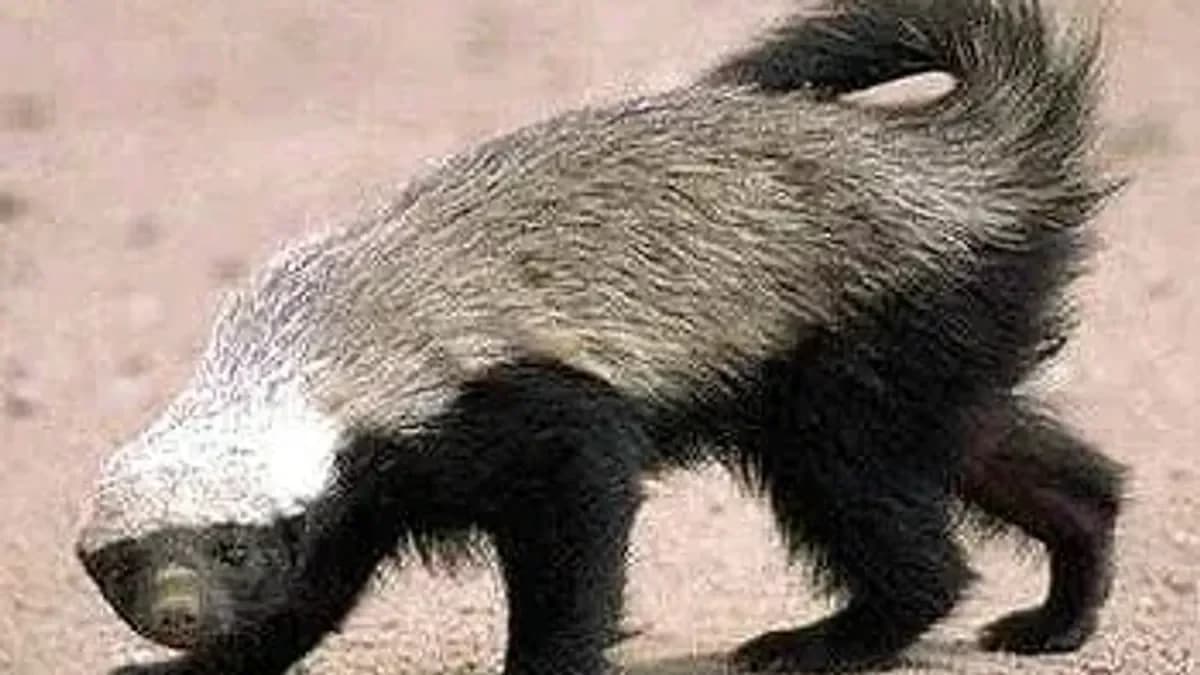
The honey badger, native to Africa, is a mustelid weighing little more than ten kilograms. Despite its modest size, it doesn't hesitate to take on prey that would send much larger animals running, including venomous snakes. This fearless behaviour has earned it a place in the record books as the most fearless animal on the planet. Field studies have shown that these animals can be bitten by a Cape cobra, collapse temporarily, then get back up to carry on with their meal — including the snake itself.
A microscopic mutation that neutralises the venom
The venom of elapids, a family of snakes that includes cobras and mambas, works by binding to the nicotinic acetylcholine receptors found in muscle cells. This binding blocks the transmission of nerve signals, causing muscle paralysis and often death from respiratory failure. In the honey badger, however, a genetic mutation alters the structure of this receptor, rendering the venom harmless.
A study led by researchers at the University of Minnesota revealed that the CHRNA1 gene, responsible for producing this receptor, carries a specific mutation in honey badgers. This mutation replaces an amino acid with an arginine at a key site, preventing the neurotoxins from binding there. It's rather like altering a lock so that a key can no longer fit into it. As a result, despite the venom's temporary effects, the honey badger manages to survive.
A small group of immune animals
The honey badger isn't the only animal to have developed resistance to cobra venom. Other mammals, such as mongooses, hedgehogs and even some pigs, have shown similar adaptations. Although these species evolved independently, they share biochemical mechanisms that allow them to counter the effects of neurotoxins. Mongooses, for example, have a genetic substitution that creates a glycosylation site on their receptor, preventing the venom from binding.
Hedgehogs and pigs, meanwhile, also have an amino acid substitution similar to that of the honey badger, which protects them from the venom's lethal effects. This evolutionary convergence is fascinating, as it shows how different species can develop similar solutions to the same threat.
Implications for public health
Snake bites are a major public health issue, particularly in rural areas of Africa and Asia. According to the World Health Organization, between 81,000 and 138,000 deaths are recorded each year, along with hundreds of thousands of cases of envenoming. A recent study even estimated that the death toll could reach between 274,000 and 513,000 a year.
Understanding how certain mammals, such as the honey badger, neutralise these toxins could open up new avenues for developing more effective antivenoms. Earlier research has already highlighted antivenoms capable of neutralising the venom of several snake species. These advances could significantly improve the treatments available to bite victims.
Far from being a reckless animal, the honey badger relies on a finely tuned evolutionary strategy. Its boldness is underpinned by genetic adaptations that allow it to defy danger. Scientists continue to study these mechanisms to better understand how these animals manage to overcome deadly threats.
In short, the honey badger is a striking example of how evolution can equip certain species with extraordinary abilities to survive in hostile environments. As researchers deepen their understanding of these adaptations, one thing is certain: the honey badger will continue to fascinate and inspire anyone intrigued by the wonders of nature.