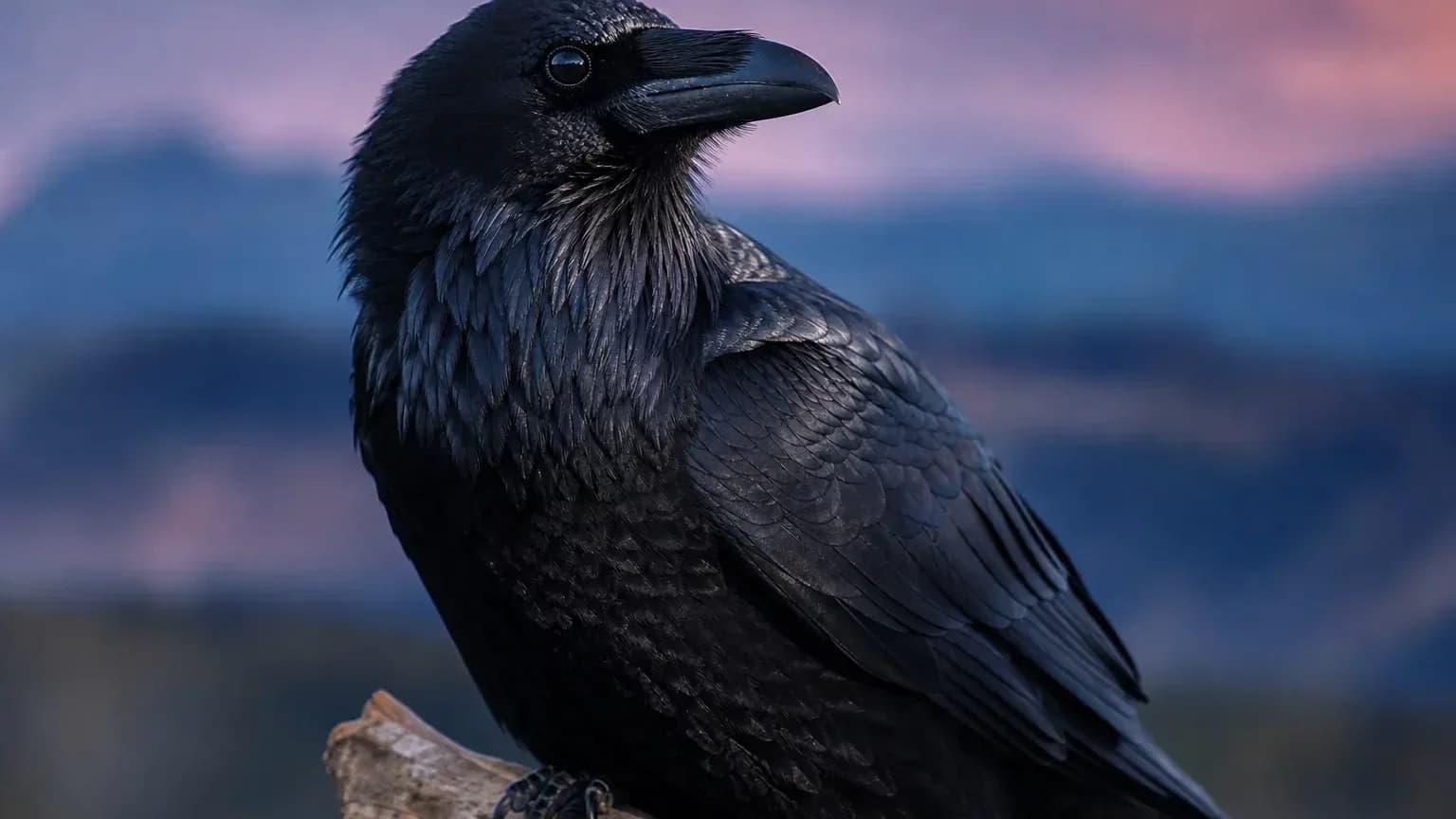
In research published in the journal Science, scientists from the Institute of Neurobiology at the University of Tübingen, Philipp Schmidbauer and Andreas Nieder, examined how quickly crows make decisions. To do this, two carrion crows were put through a touchscreen test. Their task was to judge whether a cluster of moving dots was travelling mainly to the left or to the right. To indicate their answer, they had to peck a target corresponding to their choice. Although the principle sounds simple, the difficulty of the sequences varied, forcing the birds to analyse visual signals that were sometimes ambiguous before making their choice.
Impressive performance despite the complexity
The results of the experiment were revealing. Even when the movement of the dots was hard to interpret, the crows still managed to make choices more accurate than chance alone. When the signals were clear, their success rate was close to 100%. Philipp Schmidbauer said that even faced with complex movement patterns, the crows maintained performance above random chance, reaching near-100% accuracy in the most favourable cases. The average time they took to identify the direction and signal their choice was just 235 milliseconds — twice as fast as what is observed in humans and monkeys in similar situations.
Understanding rapid information processing
To gain a deeper understanding of this phenomenon, the researchers also recorded the crows' neural activity. They focused on the nidopallium caudolaterale, a region of the bird brain associated with complex cognitive functions, comparable to certain functions of the prefrontal cortex in humans. They discovered that the first neural signals distinguishing between directions appeared just 70 milliseconds after the images were shown. Neural activity then increased gradually, reaching a threshold that corresponded to the decision being made, reflecting both the quality of the visual information and the direction chosen.
Different brains, similar mechanisms
The findings of this study highlight that, despite major structural differences, crows use neural mechanisms that closely resemble those seen in primates. Andreas Nieder noted that the neural dynamics observed in the birds are consistent with known decision-making models in humans and other primates. Although birds lack a layered cortex like mammals, their brain, with its distinct structure, appears capable of applying similar principles to process information, weigh up alternatives and trigger a response.
Adapting to their environment
The crows' speedy decision-making could also be the result of adaptations to their environment. In flight, these birds must quickly interpret visual information to adjust their course and avoid obstacles. When foraging for food, they need to coordinate movement and perception to hit their target precisely. Andreas Nieder pointed out that birds rely on their vision to carry out fast, precise manoeuvres in flight, as well as to guide their beak towards objects when searching for food.
However, the researchers believe there is still much to discover about the mechanisms underlying this decision-making speed. While this study sheds light on crows' ability to make visual decisions quickly, it does not allow us to conclude that they are generally more intelligent than humans or monkeys. What it does demonstrate is that, for a specific perceptual task, their brain can turn visual information into a reliable decision in record time.