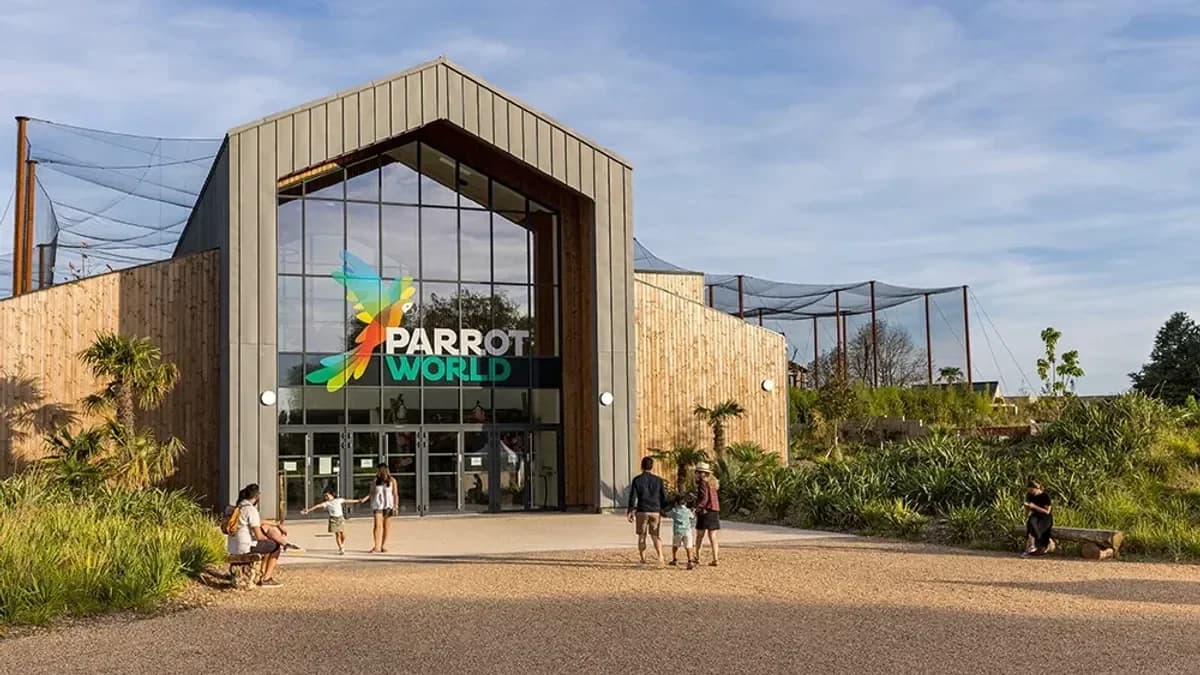
Parrot World animal park, in Crécy-la-Chapelle in Seine-et-Marne, has covered more than half of its visitor car park with photovoltaic canopies. Developed with Urbasolar, this 3.5 MWp power plant will produce nearly 4 GWh of renewable electricity a year, equivalent to the consumption of around 1,880 people.
Solar canopies over the car park
The visitors' car park is getting a makeover. Parrot World has topped it with photovoltaic canopies covering almost 1.5 hectares, or 53% of the parking area. Cars are now sheltered from sun and rain, while the panels work away above their roofs. With a capacity of 3.5 MWp, the installation turns the car park into a genuine small-scale energy production site.
Nearly 4 GWh of green electricity a year
The figures give a sense of the project's scale. The plant is set to generate nearly 4 GWh of renewable electricity every year, equivalent to the consumption of around 1,880 people. According to figures released by the park, the project avoids 62.5 tonnes of CO₂ per year. Energy produced on site, on land that was already tarmacked, without eating into any natural space.
An animal park mindful of its footprint
Parrot World is no ordinary park. Located around fifty kilometres from Paris, it immerses visitors in South American wildlife and funds species conservation efforts through the Parrot Wildlife Foundation. Covering its car park with panels extends that same philosophy, linking the welcome it gives the public to a concrete environmental commitment.
"We are proud to offer our visitors a park that is ever more committed to, and a model for, sustainable development."
Urbasolar at the controls
Design and construction were handled by Urbasolar, a solar power producer presented as a major player in the energy transition. Its approach reflects a broader trend: making use of surfaces that are already built on, such as car parks, rather than installing panels on farmland or natural land. The car park, often seen as a mere necessity, becomes a resource.
Solar power, the new go-to for leisure parks
Parrot World is not alone on this path. More and more parks are covering their car parks with panels to green their energy supply and keep a lid on their bills. In Belgium, Pairi Daiza relies on one of the world's largest wooden solar carports. The approach appeals to a public increasingly mindful of the footprint of its leisure activities. For more outings, browse our selection of zoological parks and our family day-out ideas.
A car park generating electricity while the parrots strut their stuff: at Parrot World, the energy transition parks right outside the entrance.