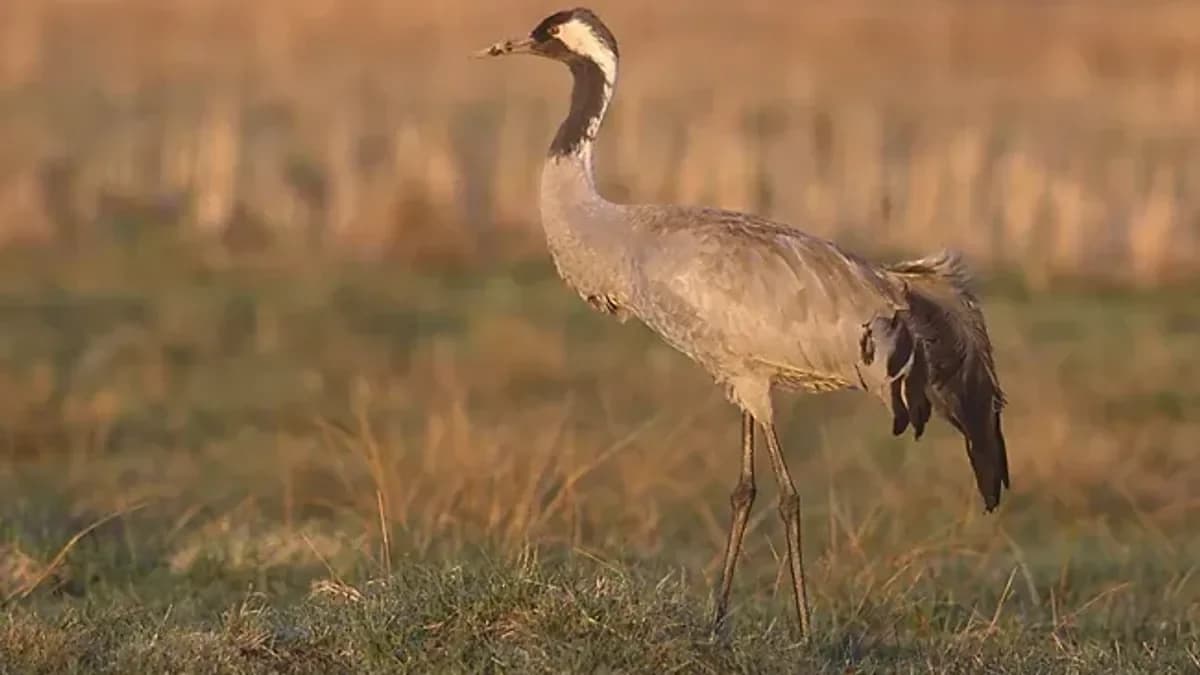
It all began in 1870, when French biologist Alphonse Milne-Edwards studied bird bones found in caves in the south of France, dating back more than 20,000 years. Among these remains, a leg bone caught his attention because of its impressive size, far larger than that of any known cranes of the time. Concluding that he had discovered a new prehistoric species, he named the bird Grus primigenia. For more than a century, this identification went unchallenged, despite the lack of solid evidence.
A revealing DNA analysis
At the time, researchers relied mainly on comparing bones to determine species. However, size can be misleading, since males and females of the same species can differ noticeably, and evolution can also play a role. This is what led John Stewart, professor of evolutionary palaeoecology at Bournemouth University in the United Kingdom, to question the original identification. Working with the Centre for Palaeogenetics in Stockholm, he set out to analyse the DNA of 18 ancient bones found across several regions of Europe, including France.
An unexpected comeback
The results of the study are striking: the famous giant crane, long thought to be extinct, is in fact nothing more than a common crane (Grus grus), a species still seen in our skies today. The prehistoric bones were simply larger than those of modern cranes. John Stewart confirms that size differences between the sexes may have contributed to the confusion. So a bird once believed extinct has in fact been migrating across France all along, without anyone noticing.
Questions remain
Despite this breakthrough, the study is not entirely complete. The original fossil studied by Milne-Edwards, held at the Muséum national d'Histoire naturelle in Paris, could not be analysed, as doing so would have required extracting DNA from it. Another question remains unanswered: why did these cranes shrink in size over the centuries? Scientists suspect that environmental changes, such as the drying out of wetlands, may be to blame, but no concrete proof has yet been found.
This research, published in the journal Royal Society Open Science, could prompt scientists to reassess other species presumed extinct. John Stewart points out that the number of extinctions recorded in the past may have been overestimated, and that some species may simply have changed in size over time. This discovery is a reminder of the importance of not relying on appearances alone, even in the field of palaeontology.