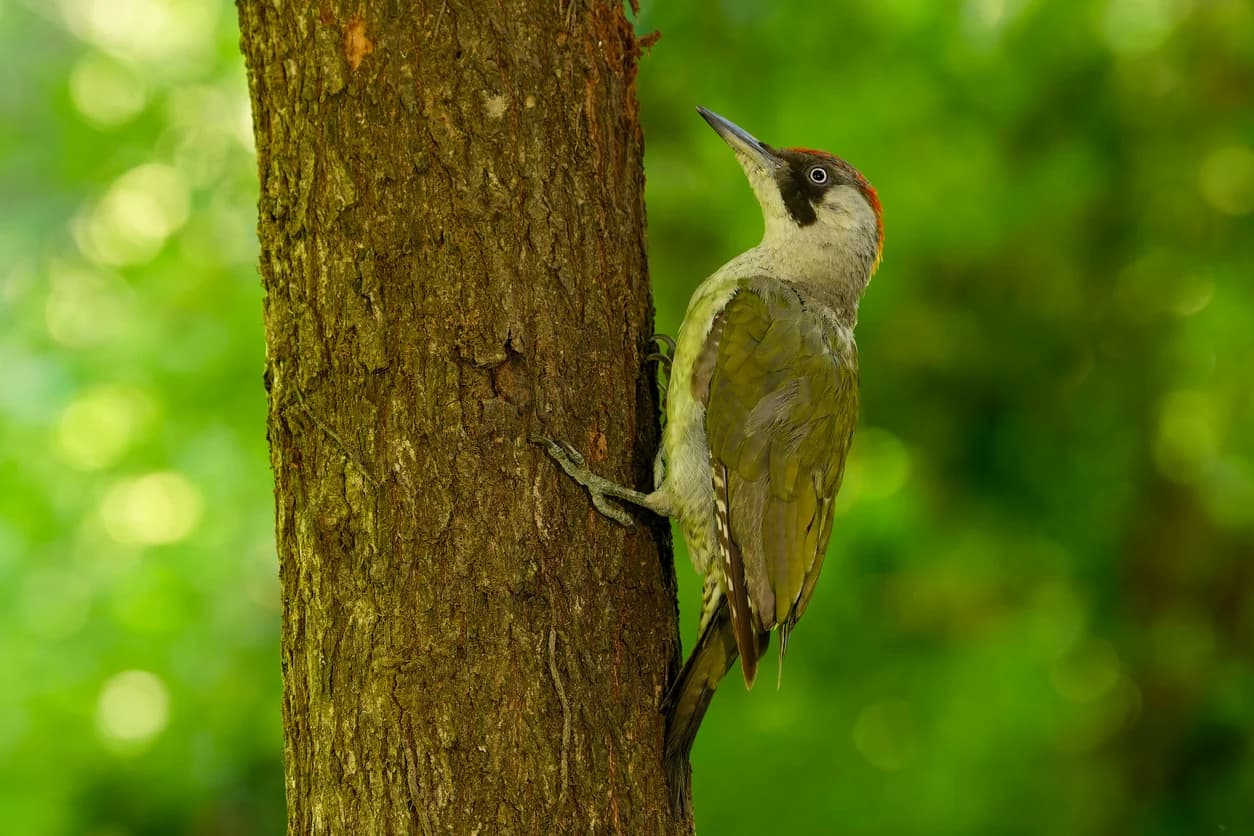
If the woodpecker hammers away at wood without ever getting dazed, it's not thanks to a shock-absorbing skull, long described as a kind of helmet.
According to a study published in Current Biology, its head acts as a rigid hammer: it's the very small size of its brain that protects it from the impacts.
The shock-absorbing skull myth
The image had everything going for it. People readily pictured the woodpecker's skull as a hard hat, fitted with structures able to absorb the energy of each strike. A reassuring explanation, repeated everywhere, that turned the bird into a marvel of anti-shock engineering. Except it doesn't hold up under the biomechanists' scrutiny.
In reality, a hammer-head
Biomechanist Sam Van Wassenbergh, of the University of Antwerp, filmed woodpeckers at very high speed, up to 4,000 frames per second. Six birds from three species, including the black woodpecker and the great spotted woodpecker, and 109 impacts analysed later, the verdict is in: at the moment of impact, the skull behaves almost like a rigid piece. A shock-absorbing skull would actually be a handicap, as it would absorb energy instead of transmitting it into the wood, forcing the bird to strike harder for the same result. The head acts as a hammer, not a cushion.
Its brain copes because it's tiny
What remains is the real feat: protecting the brain. And here, the key lies in one word: size. Striking at close to 20 km/h, the woodpecker withstands decelerations reaching 400 g, well beyond the roughly 135 g threshold considered to cause concussion in humans.
But its brain is 700 times lighter than ours. A small mass undergoes lower stress during a sudden stop, and the impact lasts such a short time that it stays below the damage threshold. The woodpecker's secret isn't armour, it's miniaturisation.
What the study doesn't yet settle
Small size probably doesn't explain everything. Other tiny birds do knock themselves out in violent collisions. The researchers point to other possible factors, such as the hyoid bone that wraps around the skull, the cerebrospinal fluid or the bone structure, and the perfectly straight trajectory of the strike, which limits dangerous rotation of the head. Van Wassenbergh's team is in fact studying these rotations, suspected of creating other stresses. Miniaturisation protects, but the full mechanics have yet to be written.
Listening out for woodpeckers in our forests
Good news: you don't need a microscope to get close to these athletes. In our woodlands, the great spotted woodpecker launches its drumming rolls in spring, the black woodpecker strikes with a deeper tone, and the green woodpecker gives itself away with a laughing-like call. Simply listening carefully on a walk is often enough to track them down. Our nature walk ideas and hiking routes are perfect for setting off to listen for them, notebook and binoculars in hand.
Next time a drumming sound echoes between the tree trunks, remember: behind that racket, a brain the size of a pea is taking it all without flinching.