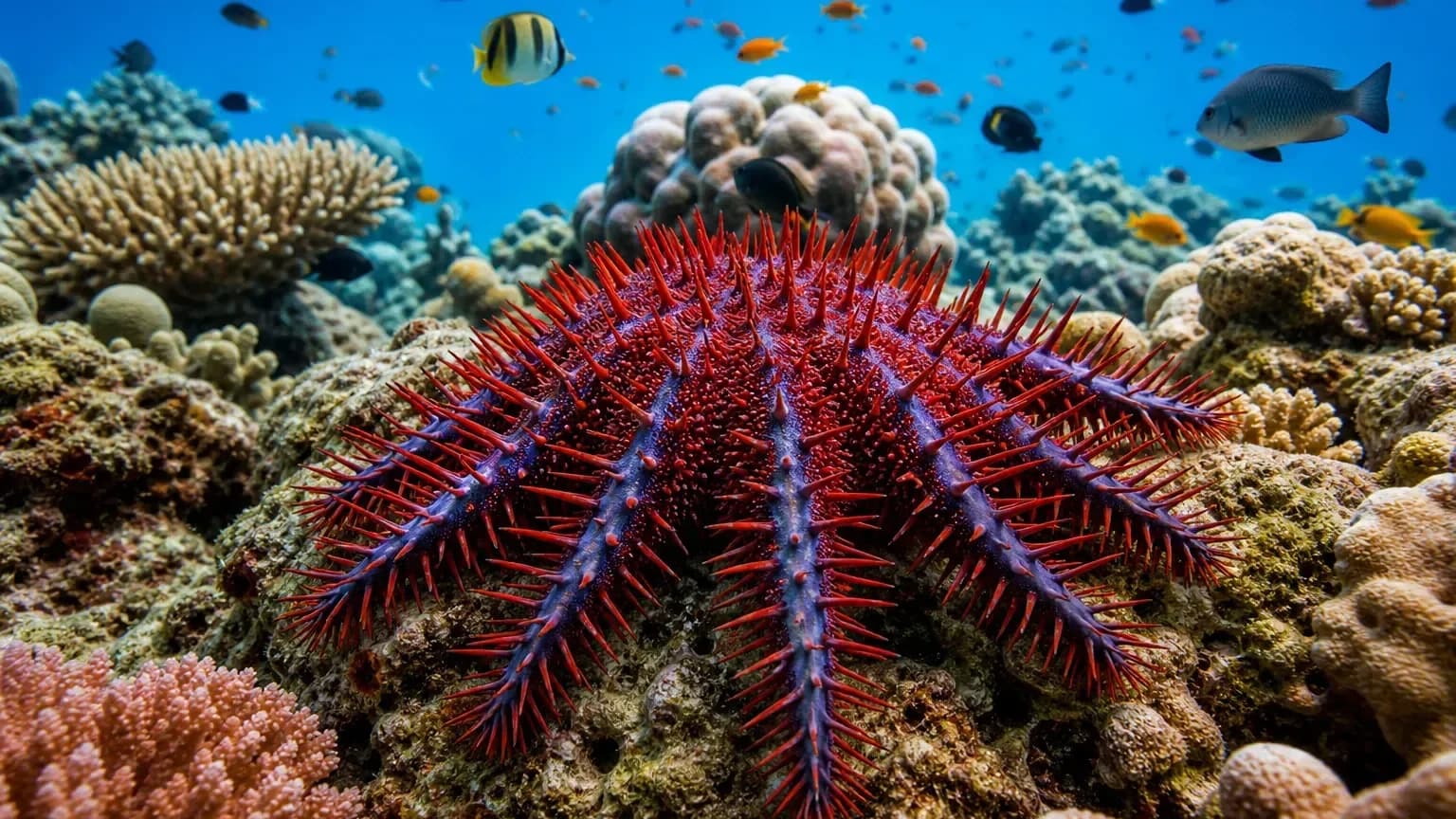
Crown-of-thorns starfish, known for their fearsome appearance and their ability to devour coral, are often seen as a scourge of marine reefs. However, research led by the University of Sydney highlights a surprising side to these creatures: when present in controlled numbers, they can actually promote the health of coral reefs.
A feared predator that can sometimes do good
Native to the Great Barrier Reef, the crown-of-thorns starfish has caused major damage to reefs during population explosions. Since the 1960s, the reef has seen four major outbreaks, occurring roughly every fifteen years. The decline of natural predators, such as giant tritons and certain fish species, has left marine ecosystems more vulnerable to these destructive events.
Unexpected findings on coral survival
In a study published in the journal Ecology and Evolution, researchers examined the impact of crown-of-thorns starfish feeding on coral. Focusing on protected sites on the Great Barrier Reef, where healthy fish populations keep starfish numbers in check, the team found that nearly 75% of feeding events left behind living coral tissue.
Dr Shawna Foo, who led the study, noted that these starfish appear to consume a fairly consistent amount of coral at each meal before moving on, rather than completely destroying coral colonies. This means living coral tissue is frequently left behind after they have fed.
A key role in coral diversity
This finding raises the question of what role crown-of-thorns starfish might play in balancing coral reef ecosystems. Some coral species, such as Acroporidae, grow quickly and can take over large areas, limiting the space available for slower-growing varieties. By feeding on these dominant species, crown-of-thorns starfish could create opportunities for other corals to thrive.
Researchers found that surviving fragments of fast-growing corals did not regrow on areas damaged by starfish feeding. Instead, regrowth occurred mainly among slower-growing corals such as Montipora and Porites. Dr Foo noted that this dynamic allows low-density starfish populations to support coral diversity by maintaining balance between different species.
The dangers of starfish outbreaks
Despite the potential benefits of limited crown-of-thorns starfish populations, researchers stress that outbreaks remain a serious threat. When their numbers increase unchecked, these starfish can cause massive destruction to reefs, making recovery difficult. The key lies in managing starfish populations to stop them becoming invasive.
It is essential to distinguish between starfish populations carrying out their natural predatory role and outbreaks that lead to lasting reef decline. Although the study was carried out mainly in protected areas, the findings could help guide scientists and conservation managers in their strategies for controlling crown-of-thorns starfish.
A balanced approach to reef management
The findings of this research suggest that wiping out every single starfish is not necessarily the best solution once an outbreak has been brought under control. Robust marine management is crucial to protect the natural predators of starfish and keep their populations at manageable levels.
Professor Maria Byrne, co-author of the study, linked these findings to a well-established ecological concept, the intermediate disturbance hypothesis. According to this theory, ecosystems can benefit from moderate, occasional disturbance, which prevents any single species from becoming overly dominant. Crown-of-thorns starfish may thus play a part in this natural balancing process.
While uncontrolled outbreaks can devastate coral reefs, smaller populations could help maintain the diversity that gives these ecosystems their value. This research paves the way for a new understanding of coral reef dynamics and the importance of managing marine species.