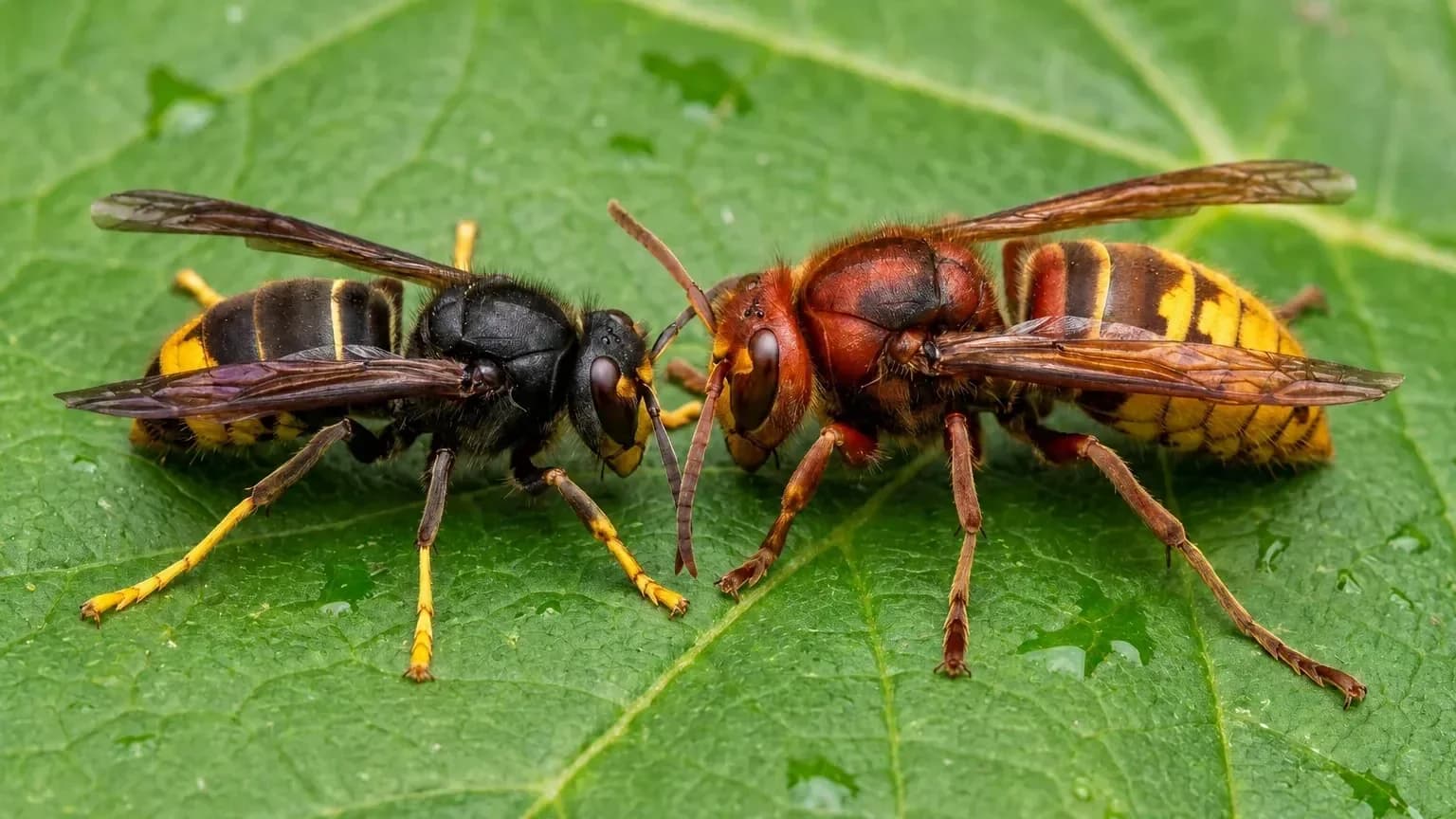
The Asian hornet (Vespa velutina) is recognisable by its yellow-tipped legs, an entirely brown-black thorax and a modest size of around 3 cm. The European hornet (Vespa crabro) is bigger and more russet, with a yellow abdomen striped with black. Two species, but only one useful reflex: observe before you act.
Three details that tell the two hornets apart
Three clues are all you need. The Asian hornet has yellow-tipped legs, an entirely brown-black, velvety thorax, and a dark abdomen where only the fourth segment turns orangey-yellow. The European hornet shows the opposite: a body marked with russet and yellow, a yellow abdomen striped with black, and brown-red legs.
Size is another giveaway. An Asian hornet worker measures around 3 cm, with queens reaching up to 3.2 cm at most. The European hornet is larger still, with queens reaching 3.5 cm. One last clue: the Asian hornet's flight is so discreet that its colonies often go unnoticed in the foliage.
A real danger to bees, put into perspective
It's beekeeping that pays the heaviest price. The Asian hornet hovers in front of hives and attacks worker bees as they return. The MNHN (French Natural History Museum) describes a genuine threat to European honeybee colonies, which have no defence against it.
For humans, the reality is far more reassuring. The MNHN is clear: the species poses no health risk to humans, and the rumour about three stings being fatal is false. A sting is painful, nothing more, unless you're allergic. ANSES (the French food, environmental and occupational health agency) adds a key point: the hornet doesn't lose its stinger and can sting more than once, and a single sting can trigger an allergic reaction in a sensitive person (source: ANSES). In 2023, hornets accounted for 38% of severe reactions, despite causing just 25% of recorded stings.
If you spot an Asian hornet nest, keep your distance
Spotted a nest? Don't try to deal with it yourself. The ARS Normandie (regional health authority) recommends staying at least 10 metres away and avoiding anything that causes vibration nearby: hedge trimming, clearing scrub, or shaking a tree (source: ARS Normandie). A disturbed colony can attack en masse.
The right approach has two steps. First, inform your town hall, which will confirm the identification and direct the report to the right people. Then let a professional destroy the nest: an improvised attempt only scatters the founding queens, who go on to build new nests nearby.
If you're stung, know the warning signs
A single sting causes pain, redness and local swelling — nothing to worry about for most people. Call 15 or 112 as soon as a symptom goes beyond this: multiple stings, a sting in the mouth, swelling of the throat, spreading hives, or feeling faint. These symptoms point to an allergic reaction, which doesn't depend on the number of stings. Anyone already allergic to stinging insects should keep their adrenaline pen close at hand.
Don't mistake your garden allies for the intruder
The European hornet, in fact, is on your side. It preys on flies and caterpillars, has no interest in your hives, and stays calm when away from its nest. There's no need to destroy it. Take the same care with its harmless look-alikes: the hairy garden scoliid wasp, the black carpenter bee with its violet sheen, or hoverflies — those wasp-mimicking flies with just one pair of wings.
Observe before you swat: that's the reflex to keep in mind on your walks in nature or a forest hike. Not sure about a creature you've spotted on a family day out? Take a photo, keep your distance, and leave it to the experts.