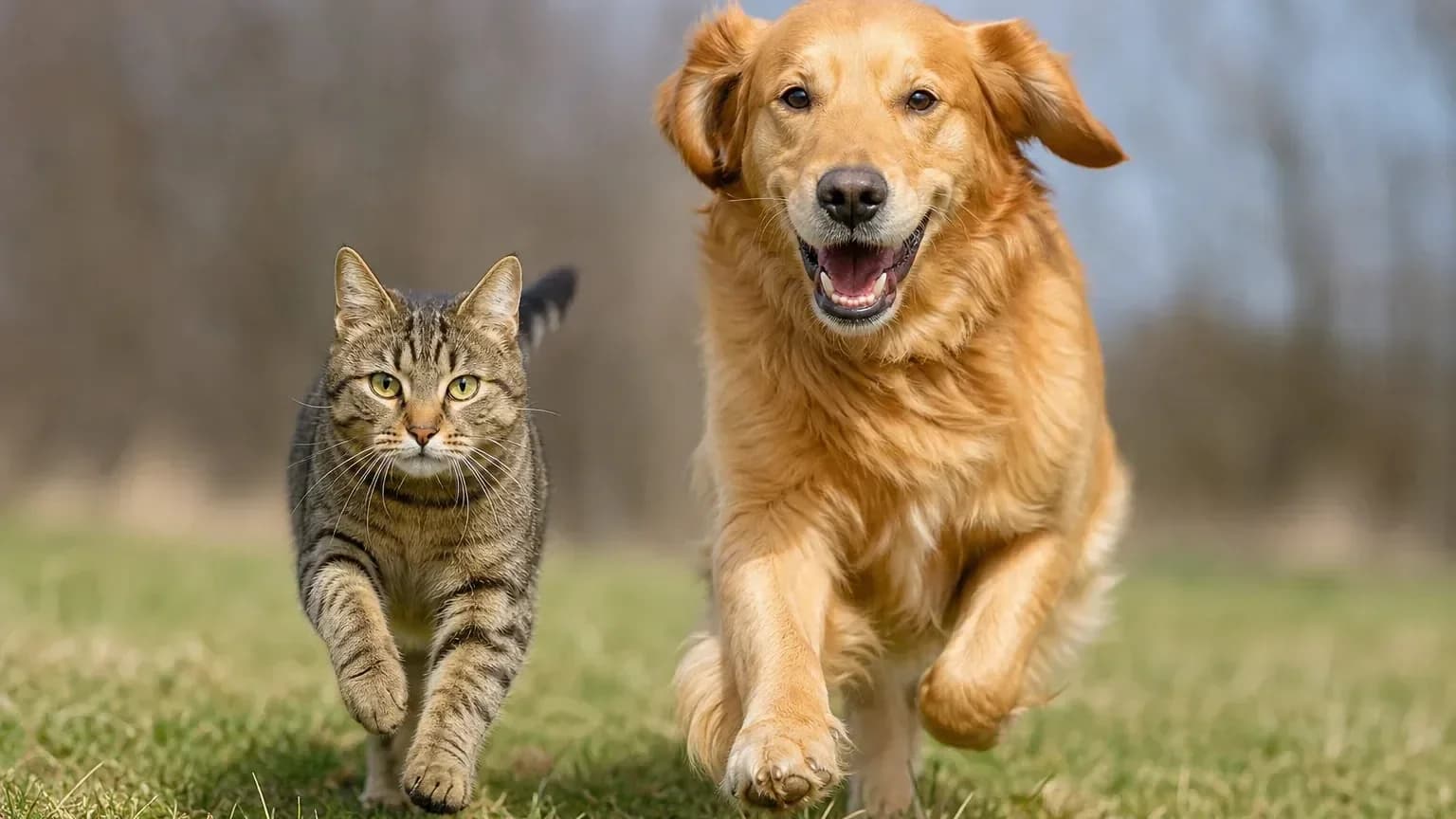
The findings of the study by Vanderbilt University, based in the United States, reveal striking differences in the brain structure of these four-legged companions. Golden retrievers, for example, have an impressive neuronal density, with around 627 million brain cells, while smaller dog breeds have around 429 million. This neuronal diversity has a direct impact on their ability to learn and adapt to their environment.
Brains go head to head: dogs versus cats

It's worth noting that brain size alone doesn't determine intelligence. The raccoon, for instance, has a brain similar in size to a cat's, yet boasts a number of brain connections comparable to that of a dog. Researchers also classify intelligence into several categories: cognitive, linked to problem-solving, and emotional, which concerns the ability to understand and interact with others' emotions. In this area, cats stand out for their logic and adaptability, while dogs are known for their empathy and understanding of human cues.
Sharp senses, different kinds of intelligence

When it comes to perception, the contest is just as close. Cats excel at smell, with 200 million olfactory cells compared to 150 million in dogs. Their night vision is also six times better than that of humans. Dogs, on the other hand, make up for this with particularly sharp hearing, able to pick up sounds of up to 45,000 Hz, while cats can hear up to 64,000 Hz. What's more, dogs are highly attuned to their owners' emotions, detecting mood changes with impressive accuracy.
Two kinds of intelligence, one shared bond with humans
Researchers have also observed signs of emotional intelligence in both animals. For example, a cat reacts differently to its own reflection than to that of another cat, while a dog adjusts its behaviour according to its owner's emotional state. These differences show how dogs and cats perceive the world in distinct ways, while remaining deeply bonded to humans.
Each in their own way, dogs and cats have developed cognitive skills that strengthen their bond with people. Dogs learn through cooperation and affection, while cats prefer to observe and imitate. Both communicate through a subtle language of gestures, sounds and scents, the result of a long history of living alongside humans.
In conclusion, it's difficult to crown a winner in this battle of wits. Each animal has its own strengths: cats act quickly and independently, while dogs excel at understanding and cooperation. These two forms of intelligence are complementary, shaped by distinct evolutionary histories, yet united by an unbreakable bond with humans. So the question remains: who's smarter? Perhaps it's whichever one has best learned to understand you.