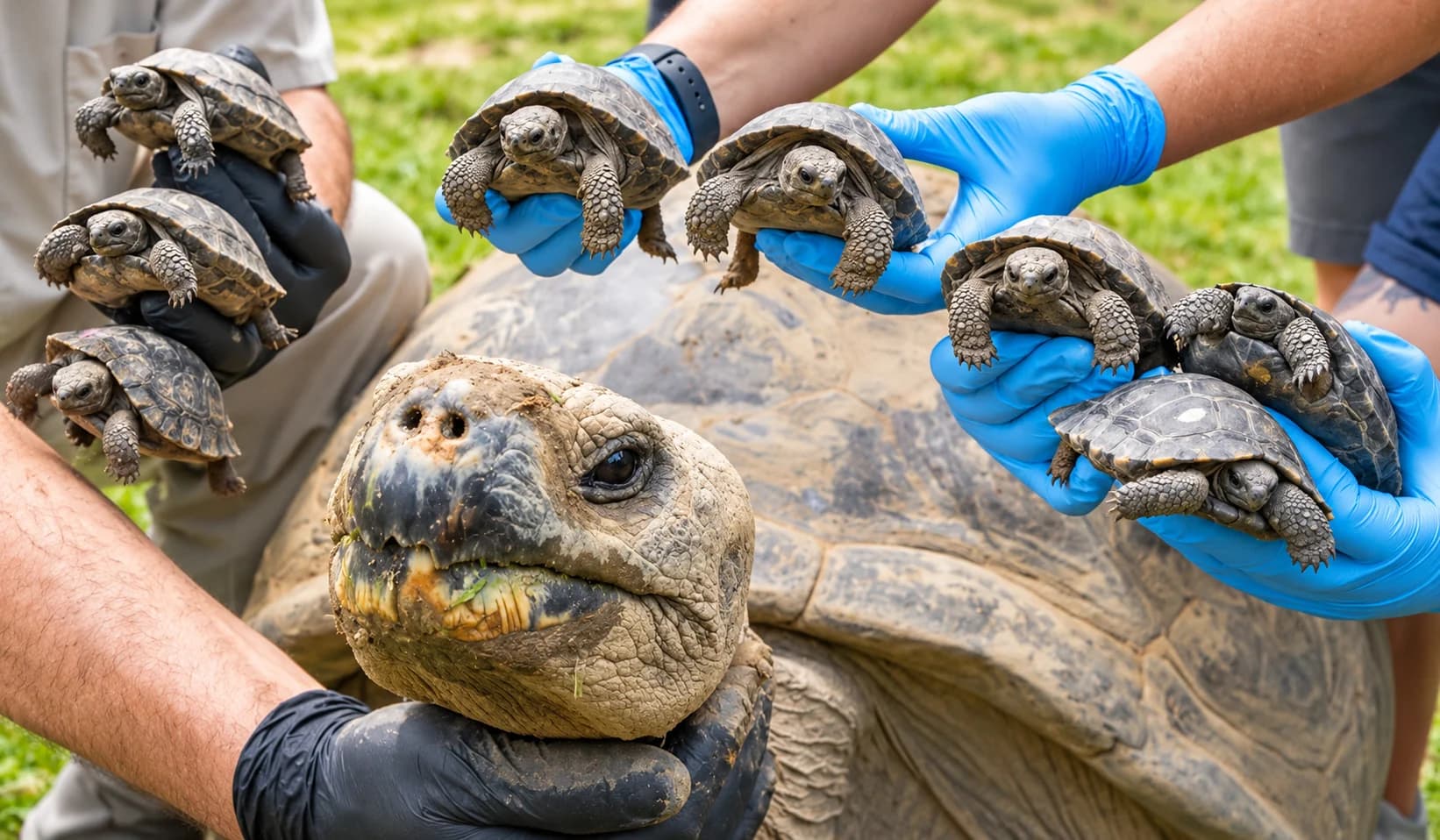
Mommy, a western Santa Cruz giant tortoise who arrived at Philadelphia Zoo in 1932, became a mother for the first time at 97 years old. Her sixteen eggs, laid in November 2024 with male tortoise Abrazzo, all hatched between February and July 2025: a first for the zoo, and a record for this species of Galápagos giant tortoise.
Sixteen hatchlings in six months for a tortoise that arrived at the zoo in 1932
Keepers dug up the clutch the day after it was laid to place it in an incubator. Sixteen eggs, sixteen hatchings, spread over five months:
27 February 2025: the first four females emerge from their shells;
in spring: three males follow;
May to July: nine more hatchlings complete the brood.
Each weighed 70 to 80 grams at birth, about the weight of a hen's egg. The zoo let the public name the first four: more than 13,000 votes chose Dorothy, Rose, Blanche and Sophia, a nod to the Golden Girls. The hatchlings made their public debut on 23 April 2025, the 93rd anniversary of Mommy's arrival in Philadelphia. It wasn't the female's first clutch: since 2023, her eggs had produced no viable offspring.
Why the zoo population has risen from 44 to 60
Accredited American zoos held 44 western Santa Cruz giant tortoises before these hatchings. They now count 60, a rise of 36%. Mommy had no known descendants, and her genes were absent from the North American breeding studbooks. Abrazzo, for his part, arrived in December 2020 from Riverbanks Zoo and Garden in Columbia, South Carolina, on the recommendation of the Association of Zoos and Aquariums' Species Survival Plan.
"In under a year, our team achieved twice what was considered almost impossible," says Lauren Augustine, the zoo's curator of herpetology. Breeding the species remains rare in captivity: before 2025, the last clutch at an accredited institution dated back to 2019. In the Galápagos archipelago, in Ecuador, the International Union for Conservation of Nature classes the subspecies as critically endangered, with around 3,400 individuals on the south-western side of Santa Cruz Island. Habitat loss, invasive species and conflicts with human activity weigh on these populations, as they do on other Galápagos giant tortoises reintroduced into their ecosystem.
What's next for the 16 young tortoises in autumn 2026
No destination has been made public for the sixteen young tortoises. The zoo's August 2025 statement announced a stay on site of at least a year, followed by a decision made with the Species Survival Plan in autumn 2026 on any possible moves to other institutions.
The age of 97 remains the zoo's estimate
Mommy's exact age has never been documented. Having arrived as an adult in 1932, she is thought to be nearly 100, and the figure of 97 reflects the team's estimate at the time of the hatchings.
The hatchlings' sex was determined inside the incubator
In this species, sex isn't decided at fertilisation but during incubation, depending on the eggs' temperature. Keepers split the clutch between two temperature settings aiming for eight males and eight females; it ultimately produced nine males and seven females. All sixteen hatchlings remain on view at the Reptile & Amphibian House, alongside the zoo's three adults: Mommy, Abrazzo and a female named Little Girl.