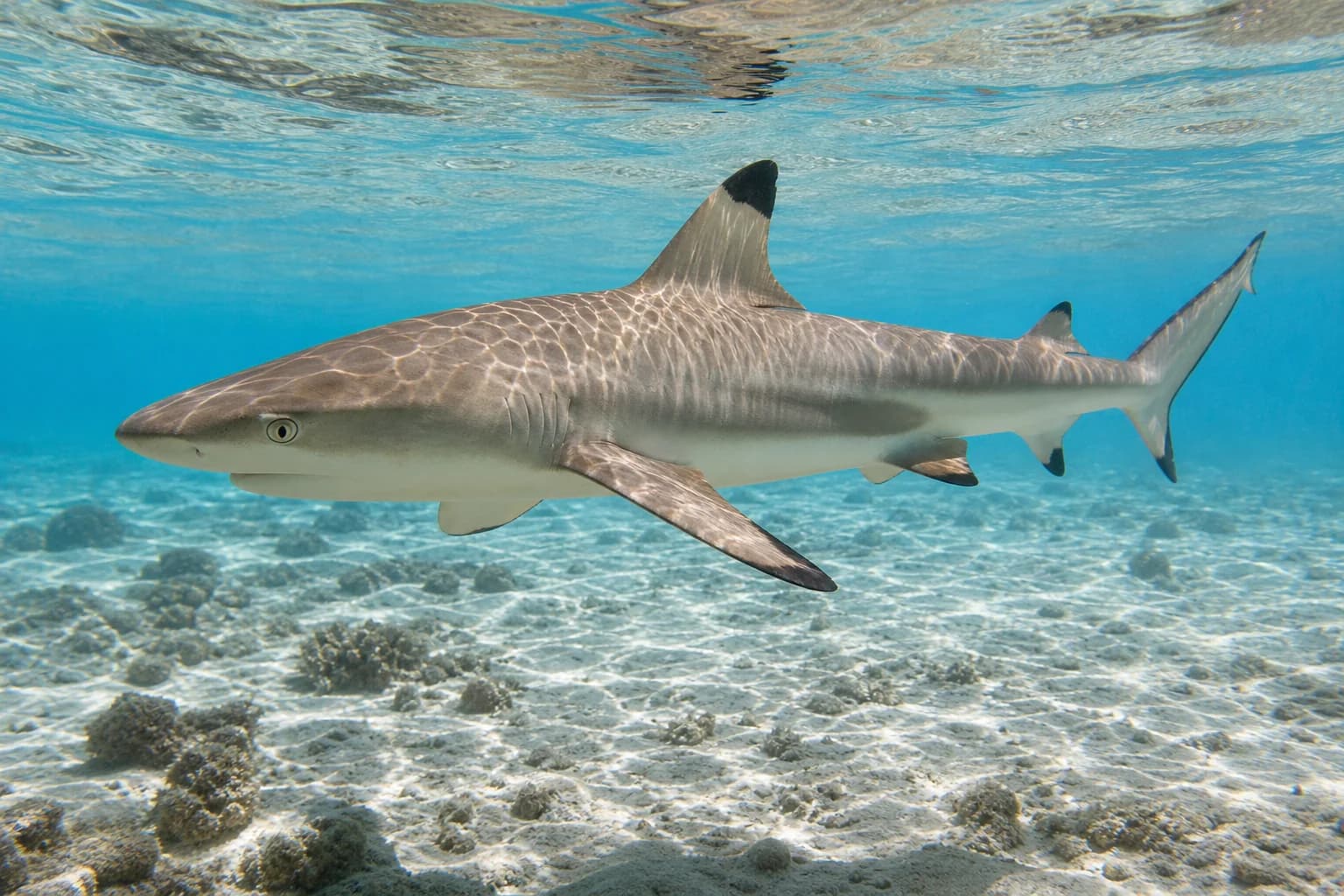
The ocean is a world of sound, and for sharks, these sounds reveal what is happening well beyond their field of vision. A new study from Florida Atlantic University has, for the first time under real-world conditions, measured just how far a freely swimming shark can hear.
An experiment off the Florida coast
Researchers studied blacktip sharks (Carcharhinus limbatus) off Palm Beach, Florida. Using an underwater speaker, a drone and wild sharks swimming naturally, they found that the animals detected sounds at considerable distances and sharply changed direction, even when the source was almost 75 metres (250 feet) away.
Low-frequency sounds detected from afar
The team played three ranges of low-frequency sounds (from 100 to 800 hertz), along with a control sound of 10 kilohertz, beyond the known hearing range of sharks. The sharks reacted to all three low-frequency ranges but remained indifferent to the control sound. More than 70% of the recorded reactions occurred in the acoustic "far field", well away from the source.
Hearing without a swim bladder
This result is all the more remarkable given that sharks lack the gas-filled swim bladder found in bony fish, an organ that helps detect sound pressure. They rely mainly on their inner ear, and on a sensory structure called the macula neglecta, which is able to detect vibrations travelling through the water.
"What makes this discovery interesting is that the sharks were reacting to sounds beyond the near field, where sound behaves differently," explains Stephen Kajiura, lead author of the study. "They detect the particle motion associated with sound, even at a great distance from the source."
What's next?
The study, published in the journal Integrative Organismal Biology, suggests that sound gives sharks information about events occurring hundreds of metres away, long before they enter their field of vision. The researchers now want to understand more precisely how their sensory system detects and interprets these distant signals.