At its sitting of 17 to 20 November 2026, the Paris Council adopted a motion calling for the gradual removal of animals from the Jardin des Plantes Menagerie, which it considers outdated. This motion carries no binding force: the Menagerie falls under the authority of the National Museum of Natural History and the State, not the City.
What the Paris Council voted for, and what it can't actually do
Paris councillors are calling on the Museum and the State to begin a "gradual transition" at the site — in other words, to phase out the animals over time. A motion at the Paris Council expresses a wish: it is not a decision.
On this matter, the City simply has no authority whatsoever: the Menagerie is a public zoological park run by the National Museum of Natural History, under the oversight of the Ministries of Ecology and of Higher Education. As far back as 2020, the Paris deputy for animal welfare was already acknowledging as much.
Why the Menagerie rankles its critics
The criticism is nothing new. The association Paris Animaux Zoopolis has been campaigning for its closure since 2019, arguing that the enclosures are too small and outdated for wild animals in the heart of the city. The Fondation Droit Animal has been calling for the same thing for even longer.
An Ifop survey commissioned by the association in 2020 claimed that 65% of Parisians supported closing it, and a petition gathered tens of thousands of signatures in late 2022. Their proposal: turn the site into an educational and scientific space, with no captive animals.
What the world's oldest menagerie stands for
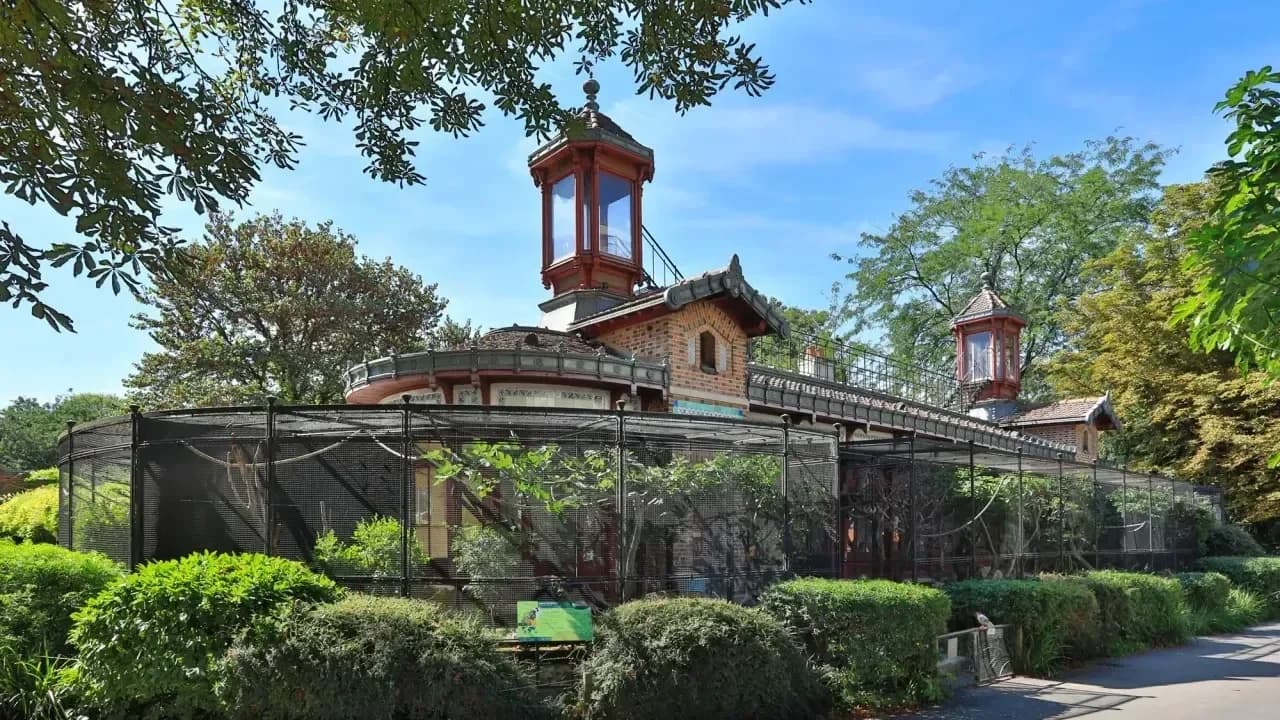
Founded on 11 December 1794, the Menagerie is one of the oldest zoos in the world still open to the public. Its buildings are listed historic monuments. The Museum points out that it has already moved on from keeping large predators: elephants, giraffes and lions left long ago, and the site now focuses on small and medium-sized species suited to its 5.5 hectares. The Menagerie is home to nearly 600 animals across 189 species, and coordinates five European breeding programmes for endangered species, from the Arabian oryx to Bornean orangutans, which moved into a new outdoor enclosure in spring 2026.
Should old city zoos be closed?
The debate goes beyond Paris. Everywhere, old-fashioned urban zoos are either reinventing themselves or closing, while large parks bet on space. A few kilometres away, the Paris Zoological Park in Vincennes, also run by the Museum, was completely redesigned in 2014 around vast biozones. Further afield, parks such as Sainte-Croix spread their animals across dozens of hectares. Against that backdrop, a pocket-sized menagerie in the city centre raises questions. The Museum, for its part, champions a place where animals are cared for, studied and protected, not merely put on display.
For now, nothing changes for visitors
For the time being, the Menagerie remains open every day, from 10am to 6pm. No timetable for removing the animals has been set, and the word "gradual" suggests a process that would be measured in years, if it happens at all. The ball is now in the court of the Museum and the State, who have not responded to the motion. In the meantime, it's still possible to see an orangutan or a giant tortoise just steps from the Seine, much like at the other zoos and animal parks that are also gradually rethinking the place of animals, sometimes out in the open countryside.