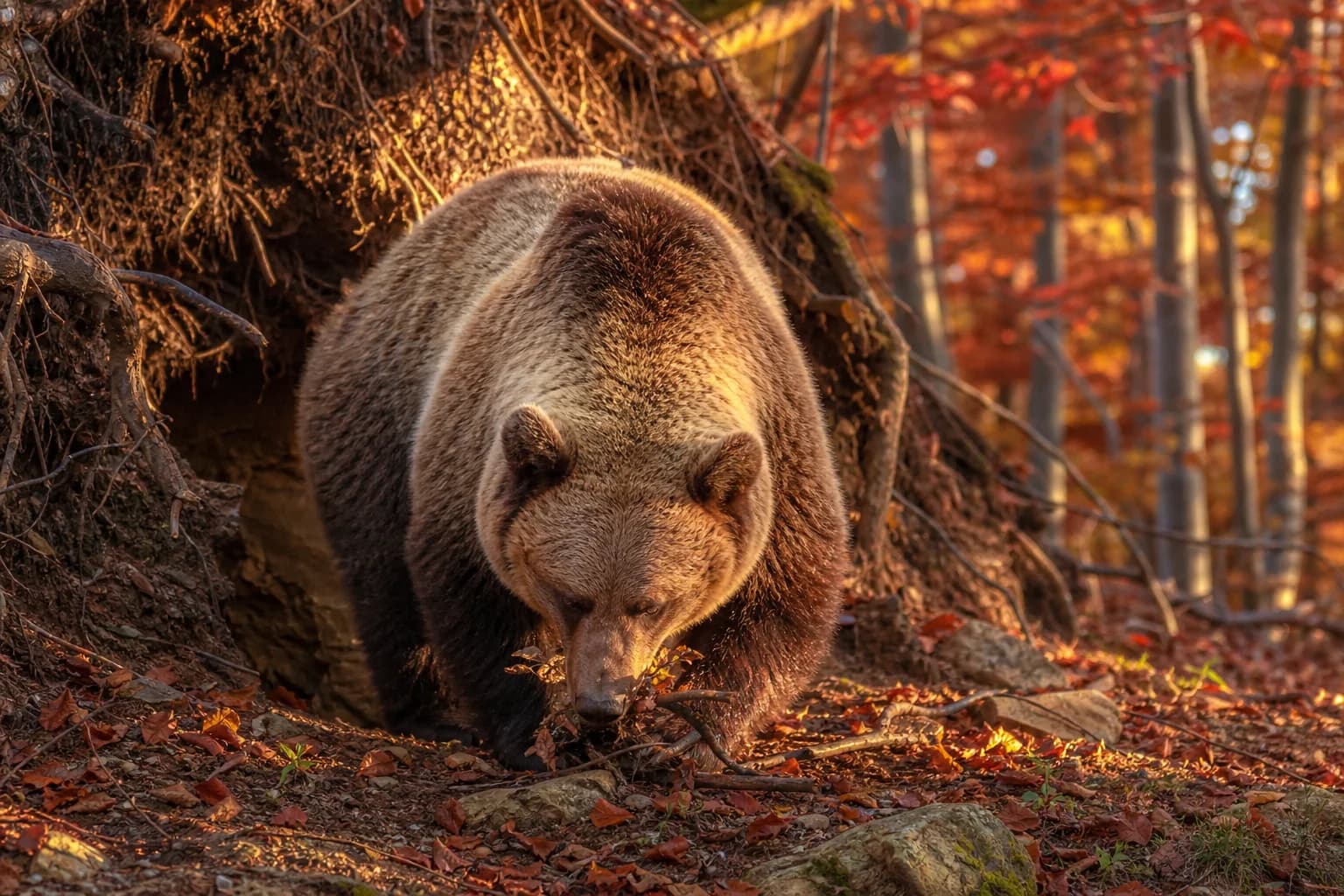
To get through winter without eating, the brown bear gorges on reserves from autumn onwards, sometimes piling on half its body weight in fat. It then retreats to its den for a long winter rest. It's not true sleep: its body slows down, but it remains able to wake at any moment.
Autumn: the big binge before the big sleep
From September onwards, everything speeds up. The brown bear spends its days eating: beech nuts, acorns, berries, roots, insects, occasionally carrion. The goal is to stockpile as much fat as possible before the lean months. A bear in good shape can gain half its body weight over the season. Biologists call this binge-eating hyperphagia. At the same time, the forest floor fills up with autumn treasures, those acorns and beech nuts the bear feasts on.
Why bears don't really hibernate
Forget the image of an animal frozen until spring. Bears don't hibernate in the strict sense, they go into winter dormancy, and the distinction changes everything. In a true hibernator like the marmot, body temperature drops by nearly 1 or 2°C. In bears, it falls by just a few degrees, while the heart rate slows dramatically. It dozes in a light sleep, wakes, turns over, and can even venture outside if the winter is mild. In the Pyrenees, some bears no longer stop completely.
The den, and births in the depths of winter
The den is nothing like a palace: a cave, a hollow beneath tree roots, lined with branches and moss. It's there, in the depths of January or February, that the female bear gives birth. Oddly enough, the embryo had been on pause since summer, and only resumes development once the mother has settled in. One to three cubs are born, hairless, blind, and weighing just 300 to 500 grams. They nurse in the warmth while their mother continues to fast.
Where to see bears in France
In the wild, the brown bear now survives only in the Pyrenees, where it remains extremely elusive. The OFB recorded at least 108 individuals there in 2025, a record, but the species is strictly protected and sightings are the exception rather than the rule. To get close without disturbing them, parks remain the best option: the Parc animalier des Pyrénées in Argelès-Gazost, the Parc animalier des Angles and the Parc de Sainte-Croix all keep bears in large wooded enclosures. Fancy some wildlife out in the open? Watching a family of beavers also offers a rare moment at dusk.
The wake-up, when spring reopens the den
As the weather warms, in March or April, the bear emerges from its den, slimmer and a little groggy. The cubs discover daylight, then follow their mother onto the greening slopes. And the cycle begins again: eating, bulking up, half-sleeping, breeding. This clock of nature, as old as the mountain itself, calls to mind those animals that have endured through the ages. A slow ballet, without fanfare, that almost no one sees. And that's exactly what makes it precious.
Your questions, our answers
Do bears really hibernate?
Not in the strict sense. Brown bears go into winter dormancy rather than true hibernation: their heart rate slows dramatically, but their body temperature drops by only a few degrees, compared with nearly 1 to 2°C in a true hibernator like the marmot. They retain partial alertness, waking regularly inside the den, and can even leave it during a mild spell. In the Pyrenees, some bears no longer stop completely during winter, an effect linked to climate change.
When are cubs born?
In the depths of winter, inside the den, most often in January or February. The female gives birth to one to three cubs during her winter dormancy. Remarkably, the embryo had been on pause since summer: development only resumes once the mother has settled in for winter. Cubs are born hairless, blind and tiny, weighing 300 to 500 grams. They nurse in the warmth while their mother fasts, then discover the outside world in spring, around March or April.
Where can you see brown bears in France?
In the wild, only in the Pyrenees, where the OFB recorded at least 108 individuals in 2025. The species there is strictly protected and highly elusive: sightings come down to luck. To approach a bear safely, animal parks remain the best option. The Parc animalier des Pyrénées in Argelès-Gazost, the Parc animalier des Angles in the Pyrénées-Orientales and the Parc de Sainte-Croix in Moselle all keep bears in vast wooded enclosures.