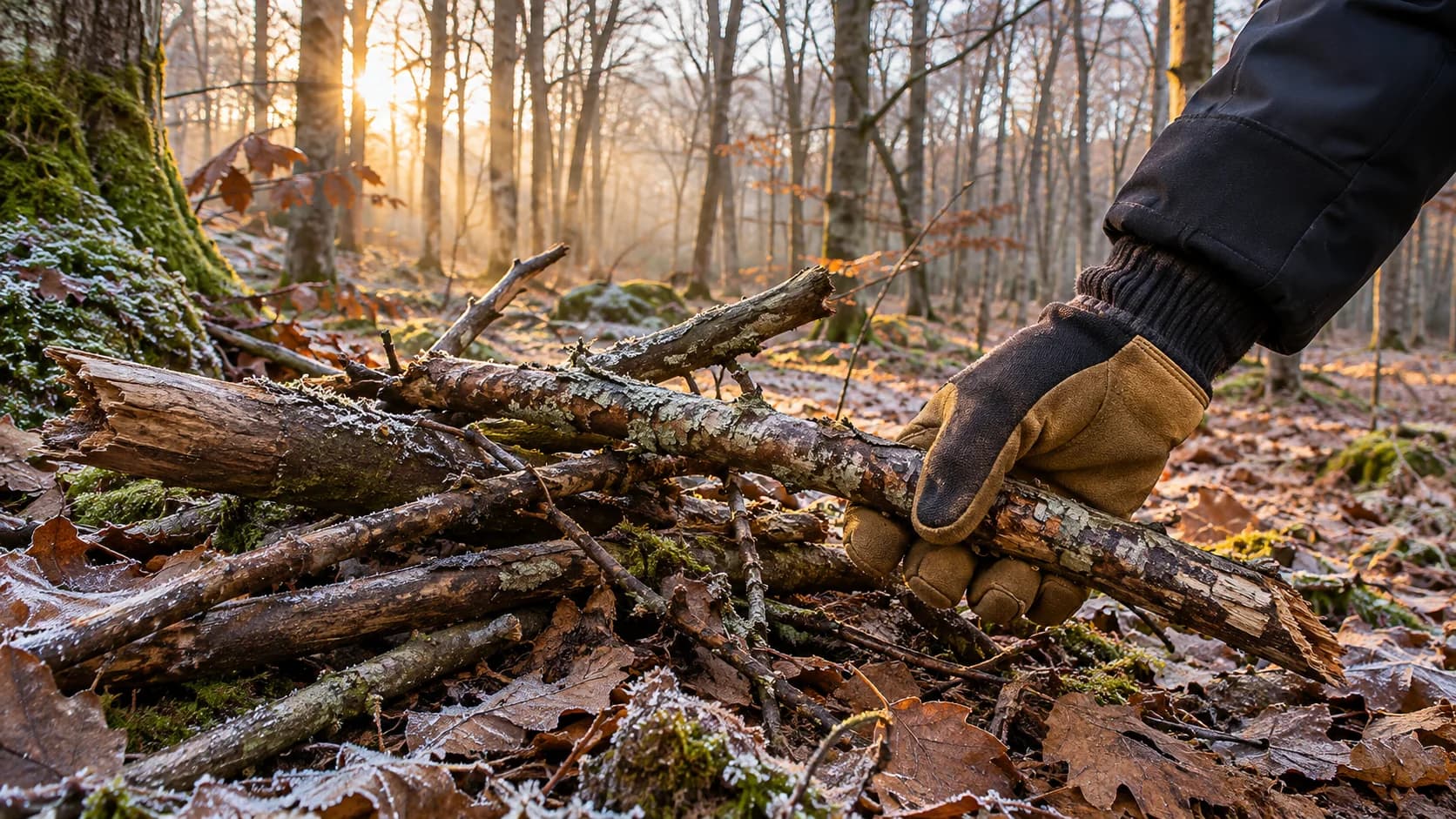
Whether you're allowed to collect dead wood in a forest comes down to a single factor: who owns the plot. In state forests managed by the ONF, it's forbidden without authorisation. In privately owned woodland, the owner's written consent is compulsory. Only communal firewood rights (affouage) open a legal route, and that's reserved for residents registered at the town hall.
Wood, even dead wood, belongs to someone
In a forest, nothing lies around ownerless. Every branch, every log, dead or alive, belongs to the owner of the land: the State, a local council, or a private individual. A branch that's fallen on its own along a path still has an owner. Taking it without permission counts as unlawful removal, exactly like picking up a fallen roe deer antler in private woodland.
State, communal or private forest: different rules apply
The legal status of the land changes everything. In a state forest, managed by the ONF on behalf of the State, a private individual cannot collect firewood, even dead wood lying on the ground: these branches enrich the soil and shelter insects, mosses and fungi. In a communal forest, only affouage rights allow any wood to be taken. In privately owned woodland, which covers three-quarters of France's forests, written permission from the owner is essential, with no exceptions.
Affouage: the only legal way in
A custom dating back to the Middle Ages still survives in the French countryside: affouage. In a communal forest, the town council can set aside felled wood for residents to heat their homes. You register on the affouage roll at the town hall, provided you have a genuine, fixed address in the commune. The wood obtained can never be resold, and quantities remain modest, often under 50 stères (cubic metres of stacked wood) per household. Articles L243-1 to L243-3 of the Forestry Code govern this age-old right.
Wood theft: fines add up fast
Helping yourself without permission comes at a cost. For small wood under 20 cm in girth, the Forestry Code applies Article R163-1: a 5th-class offence, carrying a fine of up to €1,500, doubled for repeat offenders, with confiscation of the wood and tools. Beyond 20 cm in girth, measured at 1.30 metres above ground, the law classes it as theft, punishable by up to €45,000 in fines and three years in prison. Even logs neatly stacked along a path have an owner.
The right move before you collect anything
One simple step avoids trouble: ask before you bend down. In private woodland, request written permission from the landowner. For a communal forest, check with the town hall about that year's affouage allocation. In a state forest, your local ONF office will have the answer. On the ground, though, a dead branch feeds a whole world, much like the submerged wood tended by the beaver, that river engineer. The best habit to keep, on your walks in nature, is simply to look, then leave the wood where it lies.