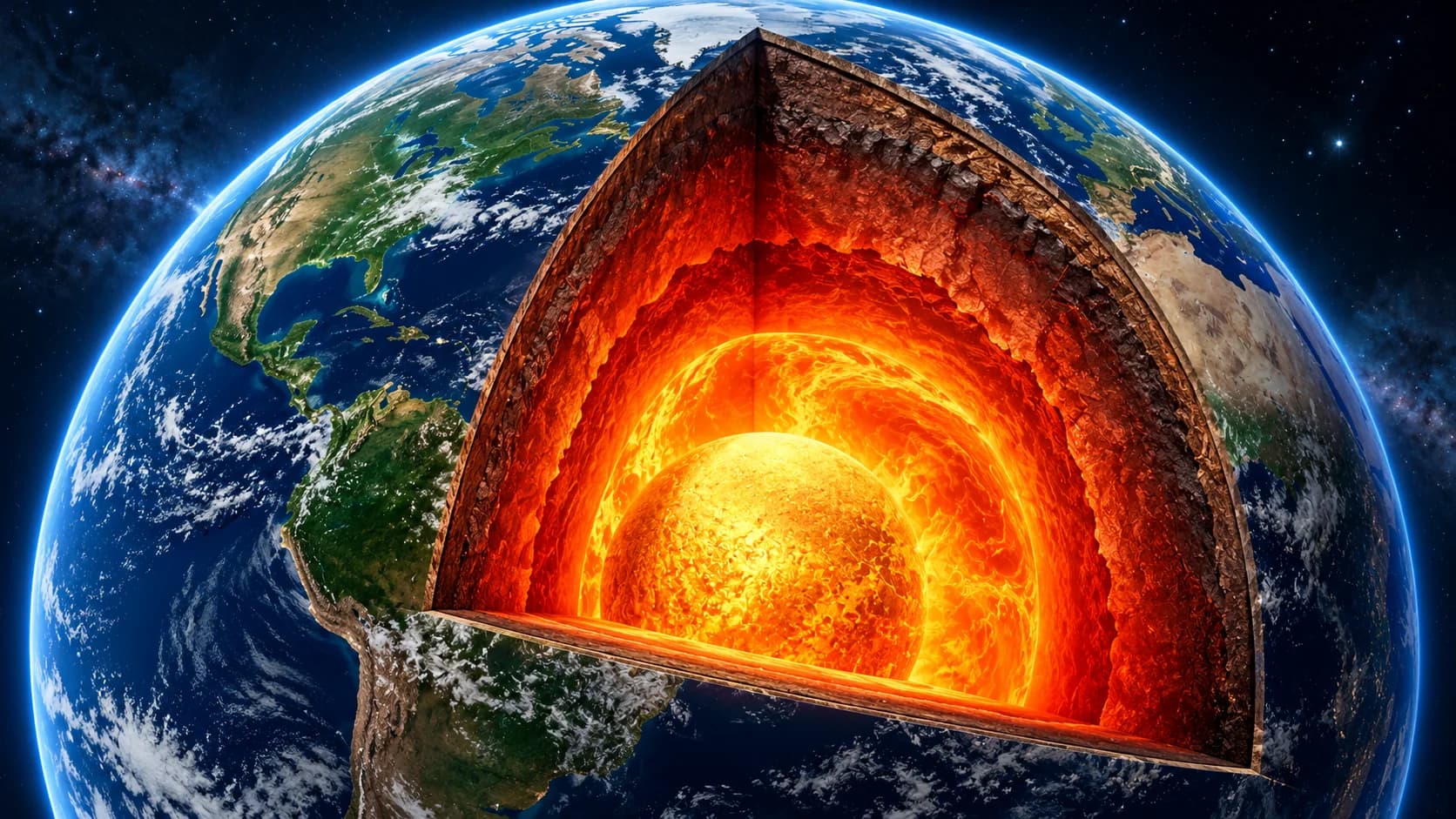
The oxygen we breathe may not come solely from plants and algae. According to a study published in National Science Review, deep magma can store far more oxygen than previously thought, and ancient volcanoes may have released enough of it to enrich Earth's atmosphere billions of years ago. It's a theory that still needs confirming.
Magma that traps oxygen deep underground
The experiment is genuinely surprising. In the laboratory, researchers subjected magma to extreme conditions: a pressure of around 7 gigapascals — nearly 69,000 times that at sea level — and temperatures of 1,200 to 1,800°C. The result was that the magma retained far more oxygen than it does at the surface, where it holds almost none. Artificial intelligence simulations confirm the trend: the higher the pressure, the more oxygen the magma traps.
Enough oxygen for an entire atmosphere?
The figures are staggering. According to a preliminary estimate, if ancient magmas released excess oxygen equivalent to just 0.27% of their weight, the total amount could, in theory, match all the oxygen present in the air today. The authors remain cautious: this doesn't prove volcanoes actually supplied it, but the possibility is now seriously on the table.
A clue in Earth's history
The geological timeline lends weight to the hypothesis. The great rise in atmospheric oxygen, between 2.5 and 2 billion years ago, coincides with a period when huge volcanic systems were forming. This surge, known as the Great Oxidation Event, could thus link the air we breathe to the eruptions of a still-young Earth.
Plants aren't the only ones to blame
That's not to say everything is being overturned. The classic explanation for Earth's oxygen remains photosynthesis: around 2.4 billion years ago, cyanobacteria began producing it on a massive scale. This study doesn't erase that; it adds a possible mineral, volcanic source to explain certain oxygen surges. The two mechanisms could well have combined.
A hypothesis still awaiting confirmation
Nothing is settled yet. The work is based on experiments and models, not direct measurements of the primitive atmosphere, notes ScienceDaily. Further research will be needed to settle the matter. Still, the idea is fascinating: understanding where our oxygen comes from helps us better grasp how a planet becomes breathable, here and elsewhere in the universe.
The air we breathe may, in part, come from the Earth's fiery depths. An idea worth following, even if it isn't yet set in stone.