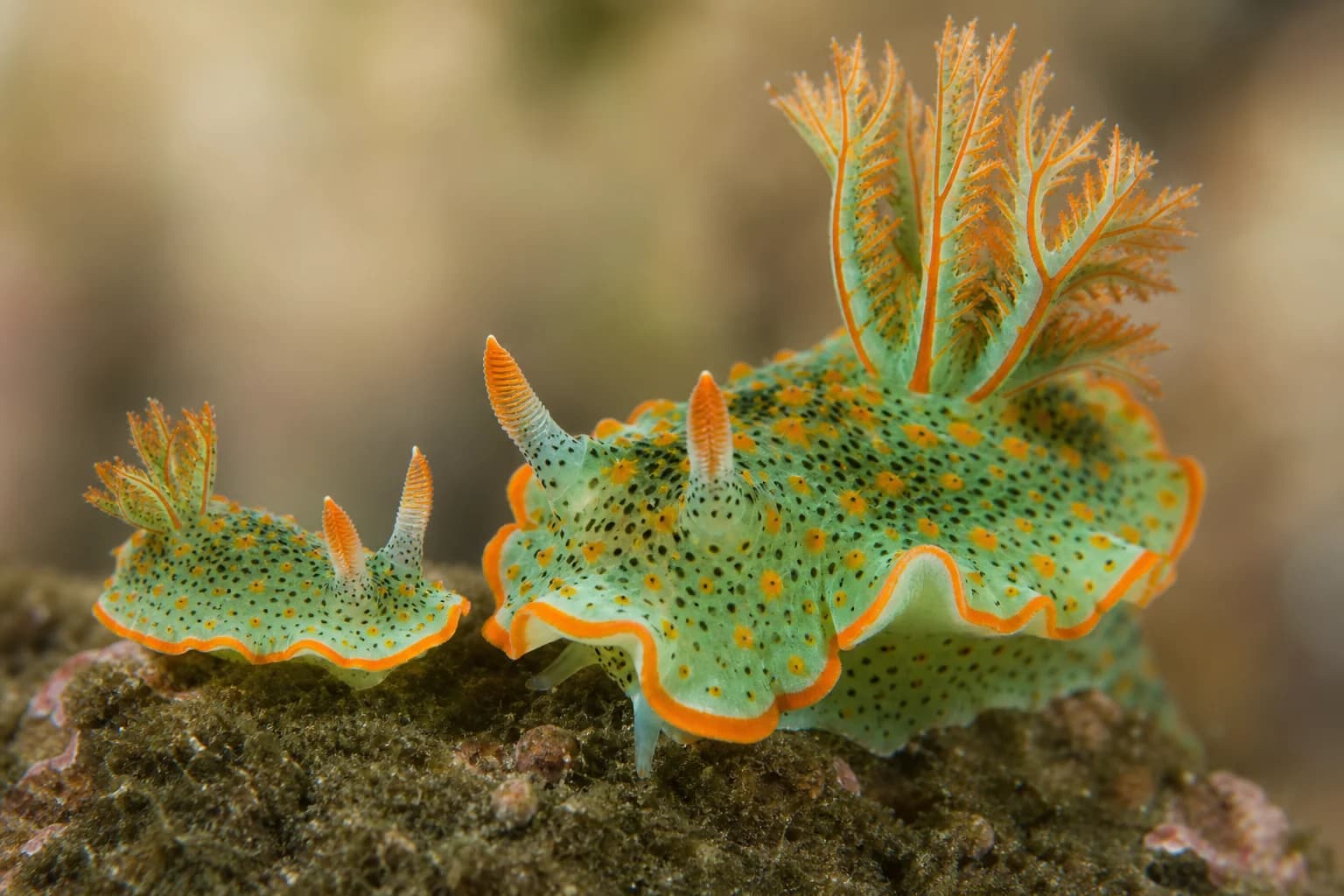
In March 2021, two biologists from Nara Women's University, Sayaka Mitoh and Yoichi Yusa, published a study in the journal Current Biology, revealing the astonishing ability of certain sea slugs of the genus Elysia to shed their bodies and grow an entirely new one. This regeneration phenomenon, well known in some animals, had never before been observed in an organism with a heart.
A fascinating separation process
The sea slug's separation happens at the neck, where a delicate groove marks the breaking line. The animal concentrates its tissue around this area, and within a few hours it manages to fully detach from its body, without bleeding or showing any signs of stress. The head, which makes up around 20% of its body weight, breaks away, leaving behind the rest of its organism, including the heart, the intestine and the reproductive organs.
Fast, efficient regeneration
Once separation has taken place, the slug's head wastes no time. It quickly resumes grazing on algae, while the wound closes up in under 24 hours. This regeneration appears to be limited to younger individuals, as older ones generally do not survive the process. The researchers even triggered the separation themselves by tying a thread around the groove, prompting the animal to sever itself.
Regeneration follows a precise order, beginning with the heart and then continuing through the rest of the body. After a week, signs of regrowth appear, and around a third of young slugs manage to rebuild their entire body within about twenty days. Although other species, such as flatworms or freshwater hydra, also have regenerative abilities, none of them has a heart or organs as complex to reform. This sea slug could therefore be the first to demonstrate full-body regeneration.
An intriguing survival strategy
The question that arises is what the point of such a sacrifice could be. Escaping a predator seems unlikely, as the separation process is far too slow to evade an attacker. Instead, researchers suggest the strategy may be linked to getting rid of parasites living inside the body. Indeed, slugs infested with small crustaceans are the ones that shed their organs, as are those that leave behind only part of their body.
It's worth noting that the head must find a source of energy to survive without a stomach. To do this, it relies on a fascinating mechanism: it steals chloroplasts from the algae it eats, a phenomenon known as kleptoplasty, and incorporates them into its own tissue, where they continue carrying out photosynthesis. This store of chloroplasts could provide the energy the head needs during the rebuilding period. Researchers are now looking into the stem cells involved in this process, a line of enquiry that could have significant implications for regenerative medicine.