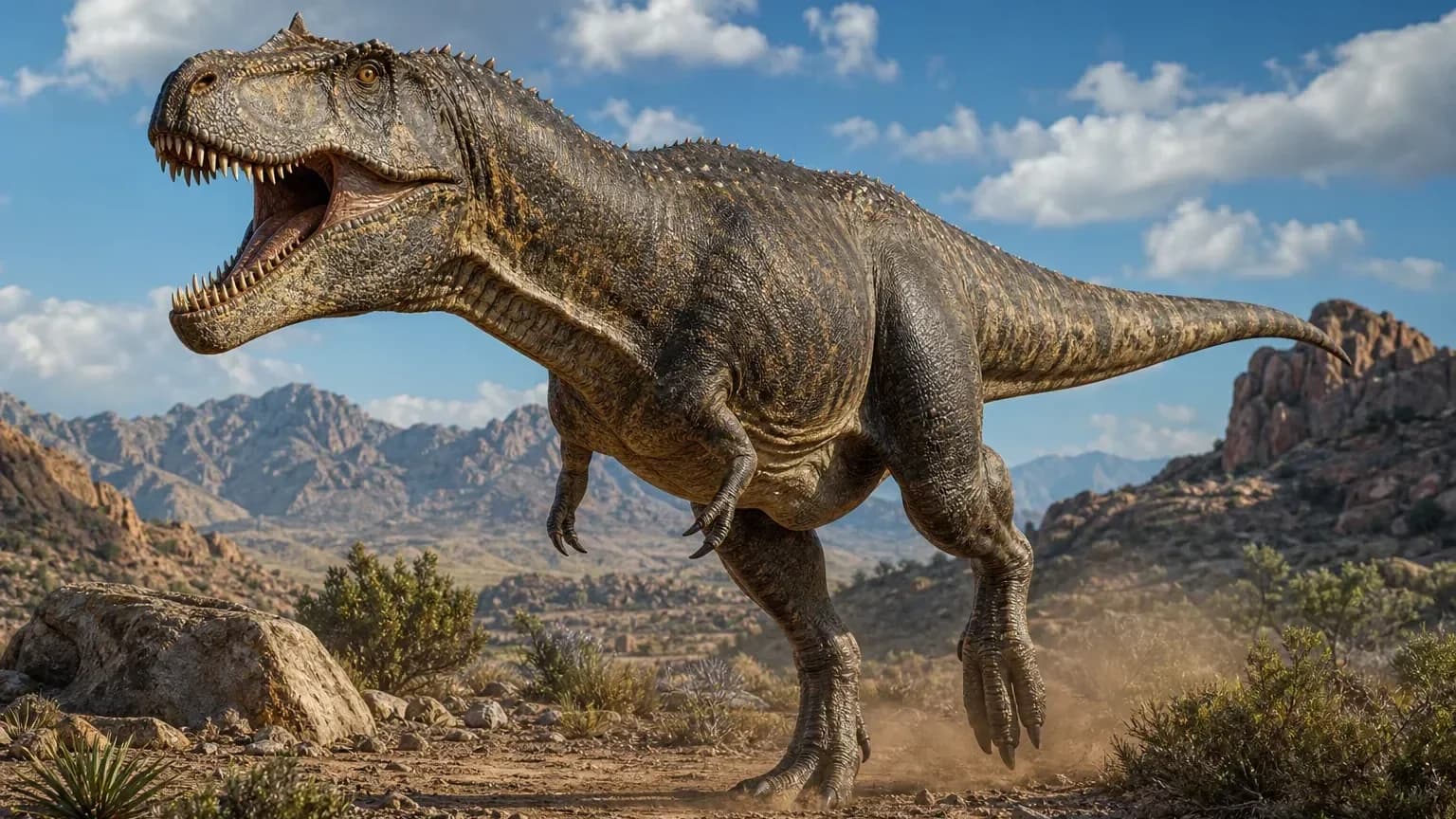
Leg bones with nothing seemingly special about them lie at the heart of a discovery that could change our understanding of dinosaurs. An international team of researchers, led by Kliti Grice of Curtin University in Australia, has published its findings in the journal PNAS. They claim to have identified mineralised red blood cells in a fossil of Aratasaurus museunacionali, a theropod discovered in north-eastern Brazil. This specimen, around 115 million years old, could represent the oldest dinosaur blood cells ever observed, surpassing previous discoveries that went back no further than 80 million years.
Promising but controversial results
Beyond simply breaking the age record, this study raises crucial questions. The researchers detected chemical signatures associated with haem, a molecule essential to oxygen transport by haemoglobin. However, these results are not conclusive, as they are based on a single specimen and the identification of the cells is open to debate. What's more, the idea of recreating a Jurassic Park is ruled out, since ancient DNA analyses came back negative.
Discovery and analysis of the fossil
The fossil, unearthed in 2008 from a mine in the Romualdo Formation, belonged to a dinosaur measuring around 3.1 metres and weighing 34 kilograms, which was four years old at the time of its death. The vascular canals in its bones, which once housed blood vessels, revealed numerous ellipsoidal microstructures, averaging 23 micrometres in size. However, Kliti Grice points out that the shape of these structures alone cannot prove their biological origin. To validate their observations, the team combined imaging, spectroscopy and molecular analyses. They found haem B and an altered form of this molecule in the bone extract. On the other hand, the surrounding rock shows signs of photosynthetic microbial life, which raises questions about the origin of the microstructures.
Experts divided
Reactions from specialists not involved in the research have been mixed. Mary Schweitzer, of North Carolina State University, voices doubts about the validity of the data on the red blood cells, pointing out that a size of around 15 micrometres seems too small for cells with a nucleus. Nevertheless, she acknowledges the presence of haem and collagen in the bone. Mauricio Barbi, of the University of Regina in Canada, finds the presence of compatible structures convincing, while noting that a degree of interpretation remains necessary. The study's authors admit that these structures differ from the red blood cells of modern birds and crocodilians, and cannot entirely rule out the hypothesis of haem-producing microbes.
For now, this discovery does not provide precise information on Aratasaurus's physiology. Kliti Grice stresses the need to replicate these results. Her team plans to examine other fossils and explore various geological contexts. At the same time, they are working to mineralise human blood using microbial mats from Shark Bay in Western Australia. If their findings are confirmed, this could pave the way for an in-depth study of the metabolism of extinct animals — though caution is still needed.
The next stage of this research could take place in museums and universities, where thousands of fossils await analysis. Some of them may hold valuable information still waiting to be uncovered. Martin Van Kranendonk, of Curtin University, also raises another angle: astrobiology. Understanding how molecules are preserved under extreme conditions could help in the search for traces of ancient life elsewhere in the universe.