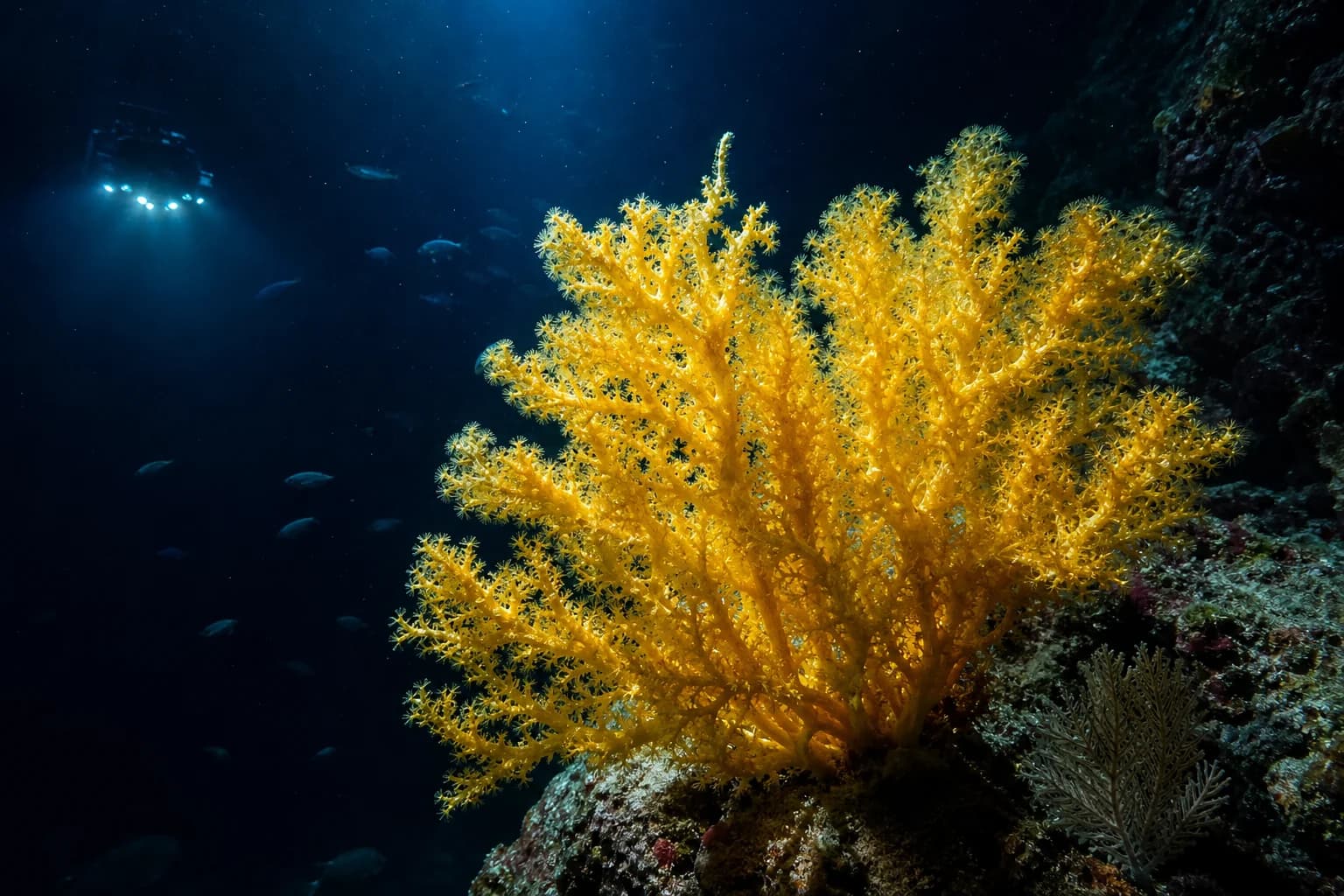
The coral, which takes the form of a small, bright yellow tree, was observed and collected at depths of between 360 and 529 metres. Thanks to footage captured by the SuBastian underwater robot, scientists were able to study several colonies of the coral, now known as Laurinque elenya.
A new species and an unprecedented classification
Although it looks rather like a plant, this coral is actually made up of numerous polyps, tiny interconnected marine animals that form its structure. Each polyp has eight tentacles to catch food, and some corals are solitary, consisting of just a single polyp. Researchers brought six specimens of Laurinque elenya back to the laboratory for detailed analysis.
During their studies, they examined the branches, polyps and the rigid structures that support the coral's tissue. However, the features observed didn't match any previously recorded coral family. Initial DNA analysis proved inconclusive, with results varying depending on which parts were examined. Scientists therefore broadened their search to other segments of DNA in order to pin down more precisely how this species relates to other known corals.
A promising future for marine research
After combining the DNA results with their microscopic observations, researchers identified a distinct lineage, leading to the creation of a new genus named Laurinque and a new family, Laurinqueidae. This is particularly significant, since a family usually groups together several related species. In this case, Laurinque elenya is currently the only known member of this new classification.
Researchers are now asking whether other members of this family exist. The six specimens collected came from just a handful of specific sites in Costa Rica's Pacific waters. Future underwater expeditions to other seamounts could well uncover further similar corals that have so far gone unnoticed. This discovery thus opens the door to new exploration and a better understanding of marine biodiversity.