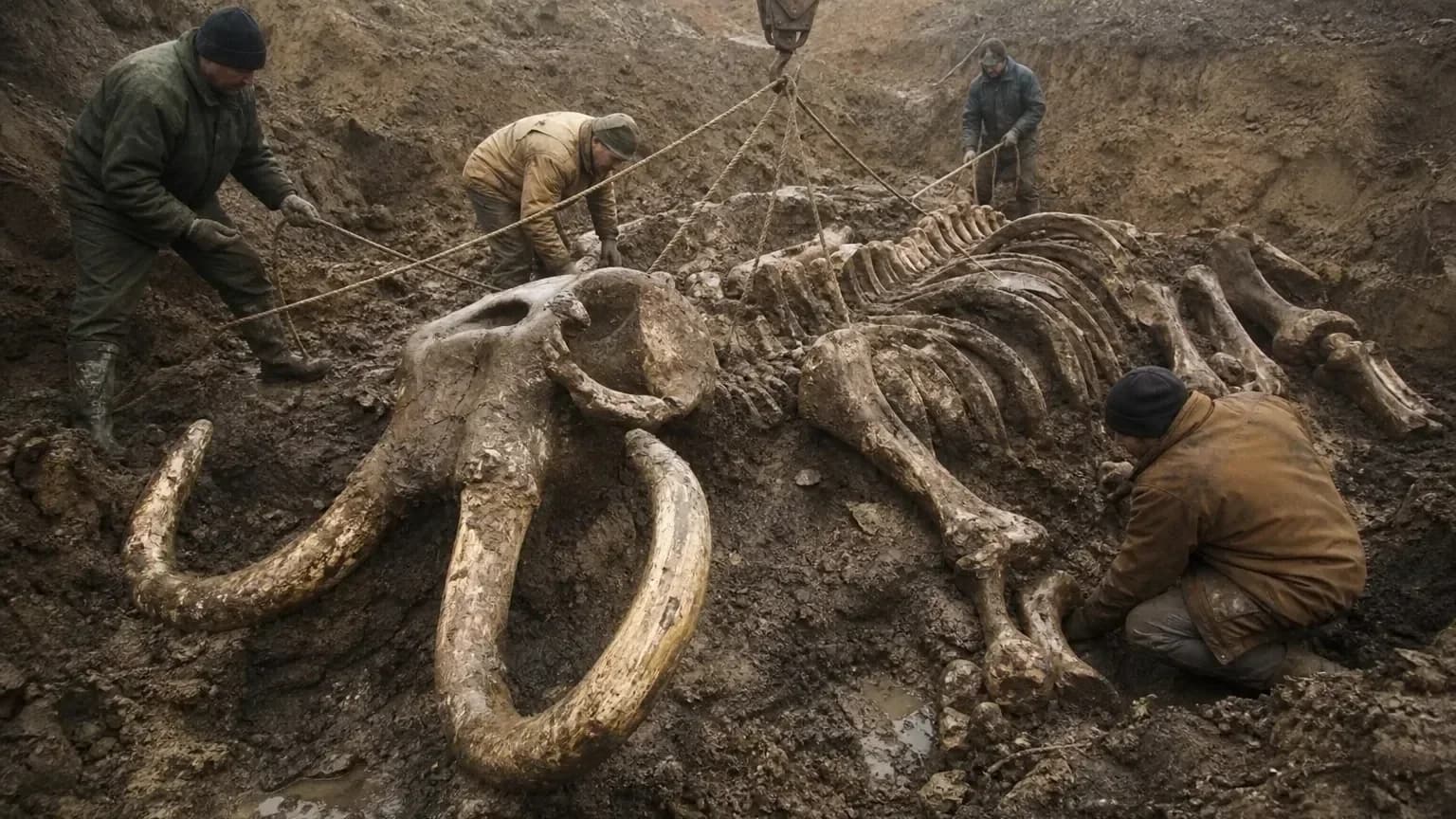
On 1 October 2015, researchers from the University of Michigan announced the discovery of a mammoth skull and its two tusks, buried in a field in Lima Township, near Ann Arbor. In this Midwestern state, mammoth remains are less common than those of mastodons, making the find all the more fascinating. The way the bones were arranged in the soil suggests possible human intervention dating back a very long time.
An unexpected find by a farmer
It was James Bristle, a farmer from southern Michigan, who made the discovery. In late September 2015, while installing a drainage system, his digger struck a curved object, which he initially mistook for an old fence post. Intrigued, he shared his find with his neighbour, and together they contacted the university's palaeontology museum the following day.
Daniel Fisher, the museum's director, visited the site that same day. The farmer had planned to resume work within 24 hours, which prompted the research team to act quickly. With the help of two volunteer excavator operators, they managed to extract around 20% of the bones, including the skull, tusks, and several vertebrae, ribs and the pelvis. Preliminary analysis indicates the animal was an adult male, likely a hybrid between a woolly mammoth and a Columbian mammoth.
Clues to ancient human activity
Alongside the bones, the excavators uncovered three stone blocks, carefully placed near the mammoth's remains. Their positioning cannot be explained by natural movement, suggesting they may have been used as weights to keep the carcass submerged in a pond. A small flake of worked stone, found near one of the tusks, may have served as a cutting tool. Furthermore, the neck vertebrae were anatomically aligned, suggesting the animal had been handled after death rather than scattering naturally.
Dating that could rewrite history
Dating the bones could also carry significant implications. Although no precise date has yet been established, estimates suggest the mammoth lived between 11,700 and 15,000 years ago. The Clovis culture hunters, regarded as the region's earliest inhabitants, appeared around 13,000 years ago, raising the possibility that humans were present in south-east Michigan before that period.
Four days after the excavation, James Bristle handed the bones over to the university for study and display. Today, the skull and tusks are housed at the Ann Arbor natural history museum. In tribute to the discovery, the farmer renamed his farm Mammoth Acres, in reference to the animal that upended his usual routine.