

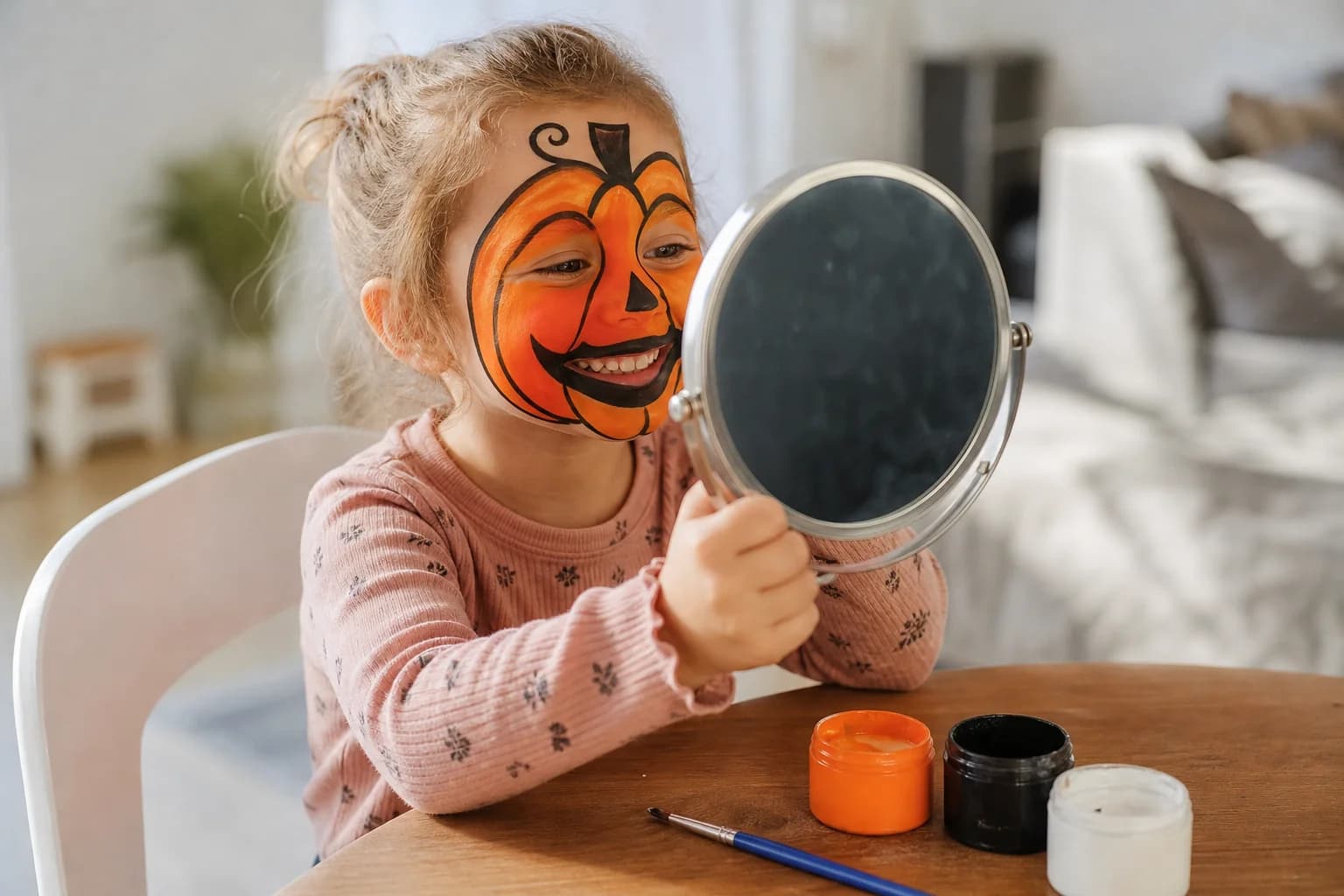
For easy Halloween face paint on a child, only one kind of kit is right for the job: cosmetic-certified water-based face paint, a sponge and a fine brush. Three designs are all you need on the night: pumpkin, little cat and spider. The golden rule comes first: a patch test in the crook of the elbow 24 to 48 hours beforehand.
The kit: water-based face paint, and nothing else
Only one product belongs on a child's skin: water-based face paint, sold as a palette, in crayon form or in pots. It dries quickly and won't stain costumes. Check for the CE mark on the packaging, and steer clear of felt-tip pens, gouache and ordinary paint, which aren't cosmetics and have no place on a face. As for tools, a damp sponge applies the blocks of colour, a fine brush draws in the details, and a glass of water with a cotton pad is all you need for touch-ups.
Safety first: the patch test in the crook of the elbow
Before the big night, one simple step protects young children's delicate skin: dab a little face paint into the crook of the elbow 24 to 48 hours beforehand, and watch for any redness. No reaction? You're good to go. On the day, avoid the immediate area around the eyes and lips on very young children: the skin there is extremely thin, and anything near the mouth tends to end up swallowed. Also check that no spots or redness are already present on the face before you start.
The pumpkin, the easiest design of all

Sponge an orange base over the whole face, working around the eyes.
Using the brush, paint two black triangles above the eyebrows and a small one on the nose.
Draw a wide black zigzag mouth running from one cheek to the other.
Add a touch of green at the top of the forehead to represent the stalk.
In four simple steps, the neighbourhood's finest pumpkin is ready to go.
The little cat and the spider on the cheek

For the cat, whiten the muzzle around the mouth, add a small black triangle on the tip of the nose, three whiskers on each side and two black points on the forehead to serve as ears. For the spider, there's no need to cover the whole face: a black circle on the cheek, eight legs radiating outwards, and a small grey web at the corner of the eye. Both of these designs work even on children who can't sit still, since they focus on just one area.
The bat, as a little mask
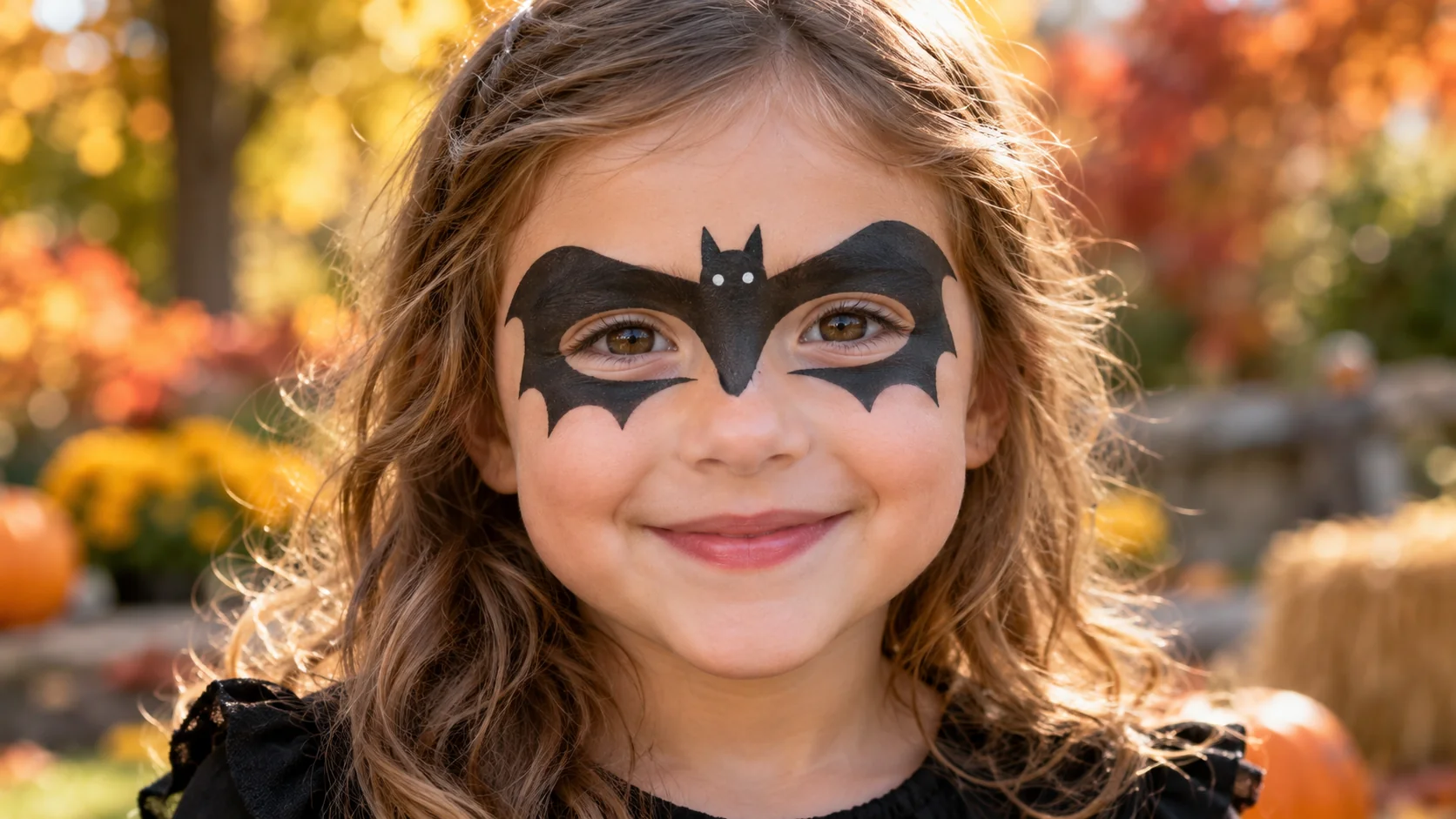
For a bat, there's no need to cover everything: you work on the upper part of the face, like a carnival mask.
With the brush, draw the body on the nose: a small black oval, pointing downwards.
On each side, paint a large black wing running over the eyelid and cheekbone, with two or three scalloped edges for the jagged outline.
Add two small pointed ears at the top of the nose, between the eyebrows.
Two white dots for the eyes, and the bat is ready to take flight.
Like the spider, this design focuses on just one area: perfect for a child who won't stay still.
Tips to make it last
Clean, dry skin holds face paint better, so wash the face before you start. Work in thin layers, letting each one dry before adding the next, rather than one thick coat that cracks within the hour. A light dusting of loose powder sets the colours and reduces transfer onto hands. Save the bright shades for last, applied over the lighter base colours, so they stand out better. Keep a damp cotton pad close at hand to fix any line that goes astray.
Removing the face paint gently before bedtime
In the evening, remove everything before bed: warm water and a mild soap, or a cleansing milk, will take off the face paint without scrubbing. Rinse well, pat dry, then check that nothing remains around the nose and ears. Fancy keeping the fun going once the face paint is off? Check out our ideas for family outings, the parks worth visiting for Halloween and the theme parks decorated for the occasion.
Your questions, answered
From what age can you put Halloween face paint on a child?
There's no legal minimum age, but cosmetic water-based face paint is generally suitable from age 3, on healthy skin and after a patch test in the crook of the elbow. For babies and toddlers, it's best to stick to a costume and avoid the face, as the skin there is too delicate. If in doubt, ask your pharmacist for advice.
Which Halloween face paint should you choose for sensitive skin?
Choose a water-based face paint bearing the CE mark, fragrance-free if possible, and test it 24 to 48 hours beforehand in the crook of the elbow. Avoid anything that isn't a cosmetic product, such as felt-tip pens, gouache or ordinary paint. Apply thin layers and remove the product as soon as you get home to limit the time it spends on the skin.
How do you remove Halloween face paint without irritating the skin?
Warm water and a mild soap are enough to remove water-based face paint, without scrubbing. A cleansing milk or micellar water also works well on more stubborn marks. Rinse, pat dry, then check that nothing remains around the nose, ears and hairline before bedtime.


