The best-preserved cave art survived because it was painted deep in hidden recesses, cut off from air, light and temperature swings. At both Lascaux and the Chauvet cave, the entrance was sealed shut for millennia. This isolation, shielded from human breath, froze the pigments on the rock.
A shelter against time
A sealed cave is a time capsule. A stable temperature of around 12 to 13°C, still air, total darkness, constant humidity: under these conditions, a pigment laid on rock can last tens of thousands of years. The Chauvet cave, in the Ardèche, is the perfect demonstration. A section of cliff collapsed over its entrance between 22,000 and 29,500 years ago, and no one set foot inside again until its rediscovery in December 1994. The drawings had been waiting there, untouched, for over 36,000 years. The slightest draught would have been enough to damage them.
Lascaux, Chauvet: treasures turned fragile
Two jewels, two ages. The paintings at Lascaux, in the Dordogne, date back around 20,000 years to the Magdalenian period, and resurfaced in 1940 beneath the feet of four teenagers.
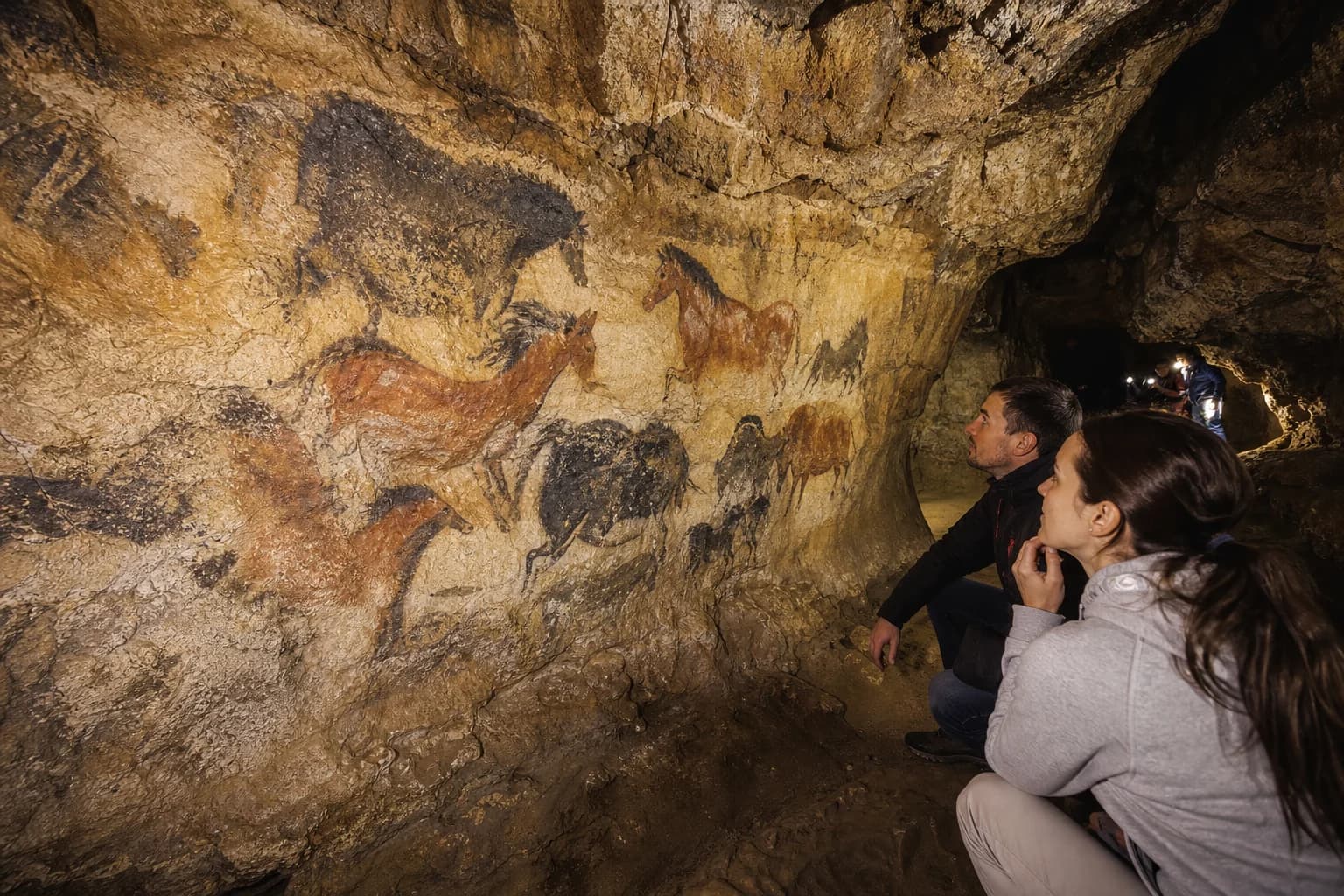
Those in the Chauvet cave are almost twice as old, among the oldest known figurative artworks in the world. On one side, horses, aurochs and great stags; on the other, cave lions, rhinoceroses and mammoths sketched in charcoal.
The paradox is cruel: what protected them now makes them fragile. Reopening the door means letting in the air that throws everything off balance.
Why close them to the public
Lascaux paid the price of its own success. Opened to visitors after its discovery in 1940, the cave was welcoming 1,800 visitors a day by the end, a million curious onlookers between 1948 and 1963. Their breathing, body heat and electric lighting saturated the air with carbon dioxide.
As early as 1960, the so-called green sickness appeared — algae spreading across the walls — soon followed by a veil of calcite. On 17 April 1963, André Malraux ordered the cave closed. Since then, only a handful of scientists have been allowed in, under close supervision. Twenty thousand years of survival, twenty years of visitors: the message was crystal clear.
Where to admire them today
Good news for families: you can now visit astonishingly accurate replicas without putting the originals at risk. In the Dordogne, Lascaux IV, opened in 2016 at the Centre international de l'art pariétal, recreates 95% of the cave at full scale. Its predecessor, Lascaux II, opened in 1983, is still open to visitors.
In the Ardèche, the Chauvet 2 Cave has been bringing lions and rhinoceroses back to life since 2015. Allow around fifty minutes for the guided tour, at cave temperature all year round, winter and summer alike. These facsimiles can be explored with children, without disturbing a single fragile surface. To plan a trip near you, browse our family day-out ideas and our nature walks.
These paintings survived 20,000 to 36,000 years in the dark. It took just two decades of light to prove the point: they are now better protected by keeping the door closed.