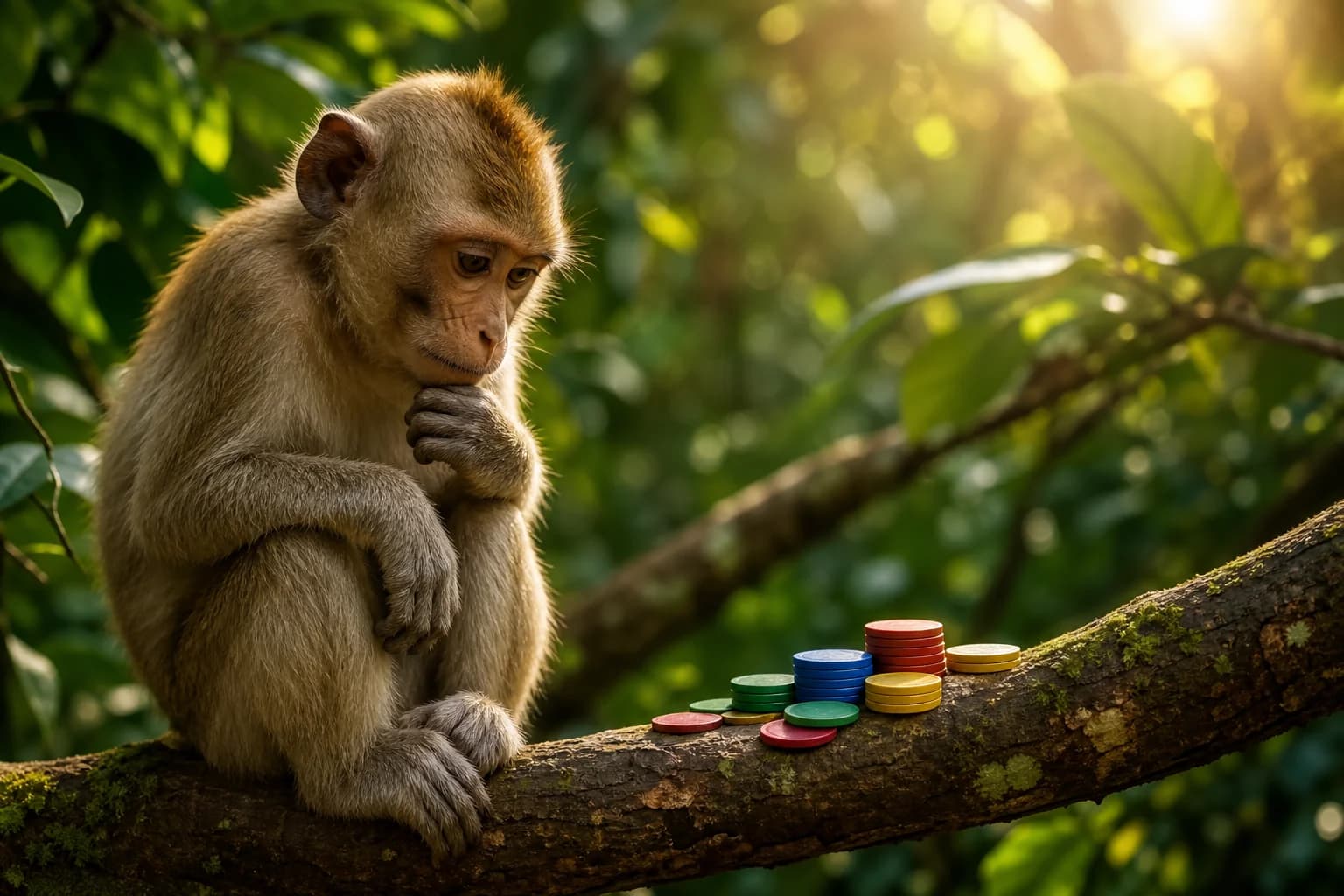
Since 2006, the work of Keith Chen, Venkat Lakshminarayanan and Laurie Santos, published in the Journal of Political Economy, has revealed that capuchin monkeys, when trading tokens for food, display behaviour remarkably similar to humans facing financial risk.
While economists have traditionally attributed these biases to cultural or educational factors, the study's findings suggest that loss aversion may be hardwired into our evolutionary past, long before money ever existed.
A curious marketplace for clever monkeys
In the 2000s, the Yale team set up a marketplace environment in which capuchins could exchange metal discs for treats. The monkeys quickly grasped the mechanism: by handing over a token, they received pieces of apple, grapes or cubes of jelly in return. They showed a remarkable ability to spot a good deal. When the price of a food item dropped, they took advantage by buying more of it, mirroring the way a human shopper responds to a sale. However, some monkeys burned through their entire allowance in no time, while others had no qualms about pinching tokens from their fellow capuchins.
Cognitive biases in action
To examine their behaviour further, the researchers varied the "sellers'" strategies. One vendor would first offer a single slice of fruit, sometimes adding a second as a bonus, while another would display two slices but often take one away. Although both vendors ultimately offered the same amount of food, the capuchins preferred the first one 71% of the time, since they perceived the addition of a slice as a gain and the removal of one as a loss. This tendency also held true in situations involving risk. Faced with a reliable seller and one who didn't always keep their promises, the monkeys chose the reliable one 79% of the time, despite the average quantity of food being identical. This shows that, just like humans, capuchins place greater weight on losses than on equivalent gains, illustrating a well-known cognitive bias.
Behaviour rooted in evolution
The findings suggest that these biases are not something learnt, but rather behaviours inherited from a common ancestor shared by primates and humans, who diverged roughly 35 million years ago. Later studies have shown that the endowment effect — the tendency to overvalue what we already own — is also present in capuchins. Laurie Santos argues that these reflexes are deeply embedded in our biology, prompting us to rethink our financial decision-making. Rather than trying to correct these biases, she advocates designing policies that take them into account, along the lines of the "nudge" approach proposed by Richard Thaler, which steers choices without forcing them. Further research continues to explore the origins of these behaviours in primates, paving the way for a better understanding of our own economy.